Hotel robot maker Yunji debuts in Hong Kong after its retail tranche is covered 5,657 times
Beijing Yunji Technology raised HK$659.6 million in gross proceeds and began trading in Hong Kong on 16 October 2025 after retail investors subscribed for 5,657.20 times the shares on offer. A Suzhou state-owned vehicle took 39.83% of the deal, leaving a small free float behind the frenzy for a company that still loses money and earns most of its revenue from hotels.
Beijing Yunji Technology, which sells delivery robots and dispatch software to hotels, began trading on the Hong Kong Stock Exchange on 16 October 2025 under stock code 2670 after raising HK$659.6 million in gross proceeds, according to its offer price and allotment results announcement filed with the exchange. The Hong Kong public tranche was subscribed 5,657.20 times.
The company sold 6,900,000 H shares at a fixed HK$95.60 each and expects net proceeds of HK$593.3 million, the announcement said. It received 260,092 valid retail applications, of which 24,813 were successful. The clawback mechanism lifted the retail tranche from 345,000 to 1,380,000 shares, or 20% of the offer. The international offering was covered 18.62 times by 83 placees, and 1,035,000 shares were over-allocated. On the first day the stock opened at HK$142.80 and closed at HK$120.50, up 26.05%, on turnover of about HK$484 million, Yunji said in a company release.
The book was concentrated. Hongkong Embodied Intelligence Capital Limited, which the announcement says is wholly owned by Suzhou State-owned Capital Investment Group, itself owned by the Suzhou state assets regulator, and by Suzhou New District State-owned Capital Holding Group, was allocated 2,748,000 shares, or 39.83% of the offer. At the offer price that stake is worth about HK$262.7 million. The exchange filing classifies the buyer as a close associate of an existing shareholder and records a lock-up to 15 October 2026. The top five placees took 76.93% of the offer and the top ten 88.84%. Shares free of any disposal restriction at listing were worth roughly HK$660 million, according to the filing.
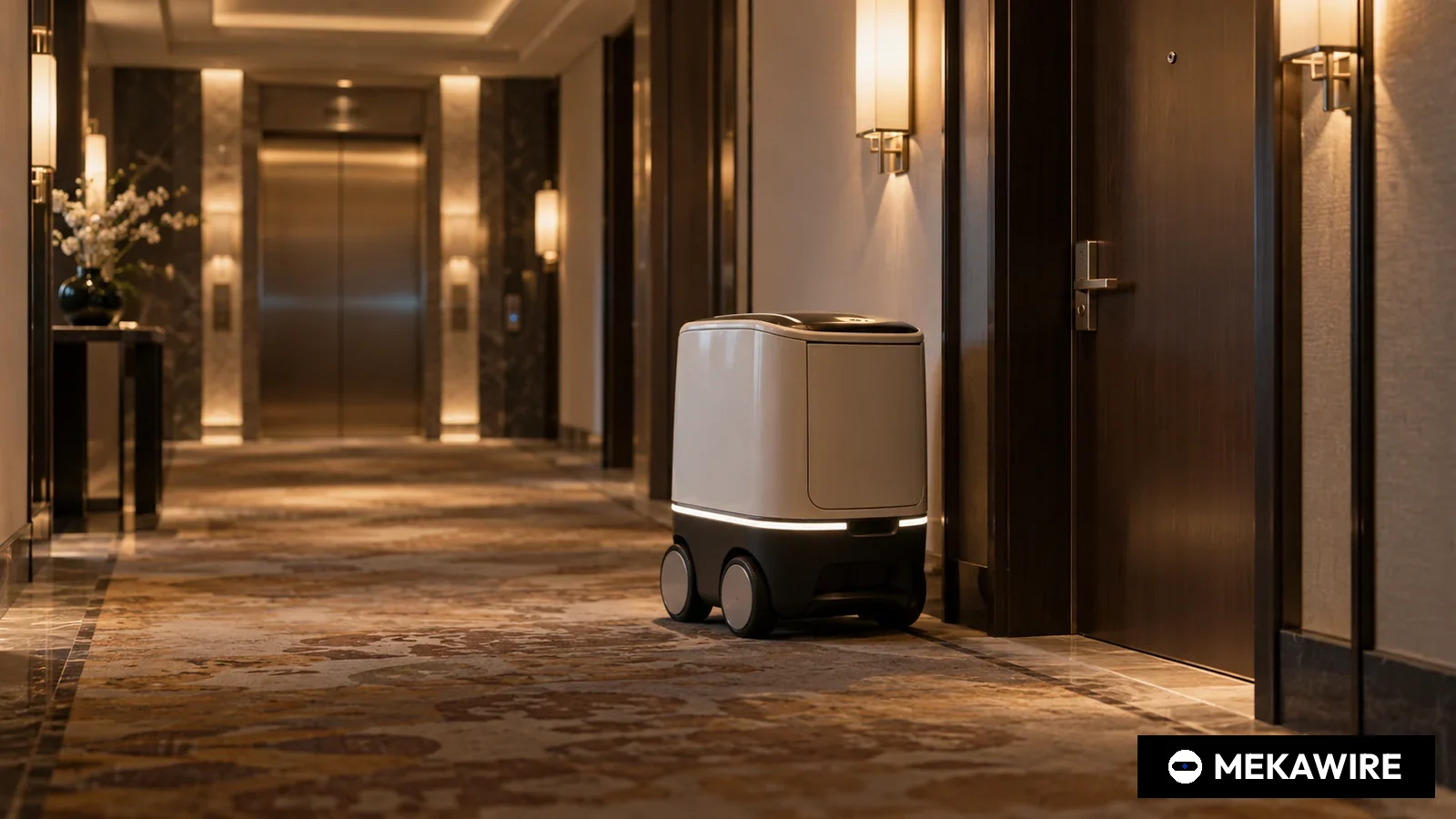
Yunji's prospectus describes three robot lines. The UP series, launched in 2023, is the current sales focus and uses interchangeable compartments so one machine can serve several tasks. The Gogo series, introduced in 2021, was the main seller during the track record period, while the entry-level Run series is being phased out. In 2024 robots and functional kits brought in RMB188.9 million, or 77.2% of revenue, and the AI digitalization system that takes requests and dispatches machines brought in RMB55.9 million. Hotels generated 83.0% of 2024 revenue and 93.2% in the first half of 2025.
The numbers show a business that is growing but not yet profitable. Revenue was RMB161.3 million in 2022, RMB145.2 million in 2023 and RMB244.8 million in 2024, a rise of 68.6% in the last year, with RMB88.3 million in the first half of 2025. Net losses narrowed from RMB365.4 million to RMB264.5 million and then RMB185.0 million, before a RMB118.3 million loss in the first six months of 2025. Gross margin rose from 24.3% in 2022 to 43.5% in 2024 and slipped to 39.5% in the first half of 2025. Cash, deposits and financial assets stood at RMB185.1 million on 31 May 2025. The prospectus earmarks 60% of net proceeds for research and development, 30% for commercialisation and 10% for working capital.
Yunji was founded in 2014 by Zhi Tao, who chairs the board. Qiming Venture Partners says it led the company's Series C round in 2021. CITIC Securities (Hong Kong) and CCB International acted as joint sponsors. The allotment announcement lists Linzhi Tencent Technology and Hubei Lenovo Yangtze River Technology Fund among holders subject to 12-month lock-ups, and puts the controlling shareholders, Zhi Tao and the Yunji Angel Management platform, at about 32.86% of the enlarged capital. Yunji listed under Chapter 18C, the exchange's route for specialist technology companies that do not meet the usual profit tests, and said it is the fourth company to use it.
The prospectus sizes what it calls China's hospitality robotic-based AI agent market at RMB3.7 billion in 2024 and projects RMB13.5 billion by 2029, a compound annual growth rate of 29.3%. Yunji ranks first with a 6.3% share of 2024 revenue, a figure that points to a fragmented field. Its closest rivals in service delivery robots, Shenzhen-based Pudu Robotics and Shanghai-based Keenon Robotics, remain privately held. Among listed Chinese robot makers in Hong Kong, the comparison below shows that Yunji raised the least but drew by far the heaviest retail demand.
- Yunji Technology
- 2670
- 2025-10-16
- 95.6
- 6,900,000
- 659.6
- 5657.2
- Geek+
- 2590
- 2025-07-09
- 16.8
- 161,405,800
- 2711.6
- 133.62
- Dobot
- 2432
- 2024-12-23
- 18.8
- 40,000,000
- 752
- 9.25
- UBTech Robotics
- 9880
- 2023-12-29
- 90
- 11,282,000
- 1015.38
- 5.16
Figures from each company's HKEX allotment results announcement or later HKEX filing. Geek+ gross proceeds derived as 161,405,800 base offer shares x HK$16.80; its retail multiple is from the Geek+ newsroom. Over-allotment excluded. Disclosed, not estimated.
As of Oct 1, 2026
At the HK$95.60 offer price the 68,718,182 shares in issue after listing imply a market value of about HK$6.57 billion, and about HK$8.28 billion at the first-day close. The prospectus values the H shares alone at HK$5,886 million at the offer price. Geek+, the warehouse robot maker that listed in July 2025, drew 133.62 times retail demand, while Dobot and UBTech Robotics drew 9.25 times and 5.16 times at their debuts.
Overseas markets remain small. Sales outside mainland China were 4.1% of 2024 revenue, according to the prospectus. Invest Hong Kong says Yunji set up an international business headquarters in the city in October 2024. On listing day Yunji announced a partnership with Luxshare Precision, the Shenzhen-listed electronics manufacturer, covering global supply chain integration, cross-region deployment and ecosystem building, without disclosing financial terms. The company also says its robots serve more than 34,000 hotels and more than 150 hospitals.
The risks are visible in the filings. The business depends on one customer type whose capital budgets swing with travel demand, and losses continue. The retail multiple was earned on 1,380,000 shares, and a single state-linked holder controls the largest allocation until October 2026. Investors will look first to the end of the stabilisation period and the fate of the over-allotment option, then to full-year 2025 results, which Hong Kong rules require by 31 March 2026.
MEKAWIRE analysis
Yunji's debut shows that Hong Kong will pay a premium for Chinese robot makers with real revenue, but a 5,657-times retail book on a float of about HK$660 million measures scarcity more than conviction.
The evidence for demand is real. Yunji grew revenue 68.6% in 2024, lifted gross margin by more than 16 percentage points in two years and cut its net loss in each year of the track record. Unlike humanoid developers, it sells a product that hotels already buy in volume, and the retail response dwarfed that of Geek+, Dobot and UBTech.
The strongest counter-argument is that the deal was engineered for a squeeze. Nearly 40% of the offer went to a Suzhou state vehicle linked to an existing shareholder, 88.84% went to ten placees, and only 1,380,000 shares reached the retail pool. The 26.05% first-day gain, below the opening high, suggests early buyers took profits quickly.
Bull case. Yunji uses the proceeds to push the UP series into hospitals, factories and offices, where its dispatch software can be resold, and the Luxshare tie-up gives it manufacturing reach abroad. If margins stay above 40% and hotel revenue falls below 80% of sales, the market will treat it as a service robot platform rather than a hotel gadget supplier.
Bear case. Hotel capital spending stalls, Pudu and Keenon compete on price, and losses persist while the RMB185.1 million cash cushion shrinks. When the 12-month lock-ups lapse in October 2026, supply from state and venture holders could weigh on a stock priced for growth.
- November 2025: stabilisation period ends and Yunji discloses whether the 1,035,000-share over-allotment option was exercised.
- By 31 March 2026: full-year 2025 results, showing whether non-hotel revenue and overseas sales above 4.1% of the total are rising.
- 15 October 2026: lock-ups lapse for Hongkong Embodied Intelligence Capital, the controlling shareholders and pre-IPO holders.
- 6,900,000 H shares
- 2670 (HKEX Main Board, Chapter 18C)
- HK$95.60 per H share
- HK$593.3 million
- HK$659.6 million
- Hongkong Embodied Intelligence Capital, 39.83% of offer
- 16 October 2025
- 5,657.20 times (260,092 valid applications)
- RMB244.8 million / RMB185.0 million
- 18.62 times, 83 placees
Why it matters
Yunji's book tells the robotics capital market two things. Retail investors in Hong Kong were willing to chase a robot story to an extreme multiple of 5,657.20 times. Local governments in the Yangtze River Delta are also willing to anchor such deals directly, as Suzhou did through Hongkong Embodied Intelligence Capital.
The second point matters more for the pipeline. A state vehicle taking 39.83% of an offer changes the meaning of oversubscription data. Future 18C robotics deals should be read by looking at allocation concentration and lock-up structure alongside headline multiples.
Rival analysis
Pudu Robotics and Keenon Robotics are the two private rivals that matter in delivery and service robots, and both sell heavily into restaurants as well as hotels. Yunji's hotel focus gives it deeper integration with property management and guest request systems, which the prospectus groups under its AI digitalization system, at 22.8% of 2024 revenue.
The 6.3% share that ranks Yunji first in its prospectus market shows how fragmented the segment remains. A listed rival with a public currency for acquisitions is new in this niche, and Pudu or Keenon would face pressure to match Yunji's disclosure if they pursue listings of their own.
Valuation context
At the offer price the company was valued at about HK$6.57 billion on 68,718,182 shares, rising to about HK$8.28 billion at the first close. Against RMB244.8 million of 2024 revenue that is a high multiple for a hardware-heavy business with gross margins around 40%, and investors are paying for growth and software attachment rather than current earnings.
The comparison with Geek+ is instructive. Geek+ raised about HK$2.71 billion on its base offer at HK$16.80 and drew 133.62 times retail demand, a far larger and more liquid deal. Yunji's tiny float inflated its multiple, so the subscription figure is a poor guide to long-term valuation support.
Supply-chain implications
Yunji's robots are wheeled indoor machines whose bill of materials is dominated by chassis, batteries, lidar or depth sensing, compute boards and lockable compartments, components that China's electronics supply base produces at scale. The Luxshare partnership signals that Yunji intends to lean on a contract manufacturer with global plants rather than build its own overseas capacity.
The prospectus allocates 30% of net proceeds to commercialisation and 60% to R&D, not to factories. That keeps capital intensity low but leaves margins exposed to component pricing and to the bargaining power of a much larger manufacturing partner.
Signals to watch
Watch the stabilisation announcement in November 2025 for whether the 1,035,000 over-allocated shares were covered by exercise of the option or by market purchases, which shows whether the aftermarket held above HK$95.60.
The full-year 2025 results due by 31 March 2026 will show whether hotel dependence fell below 93.2% and whether overseas revenue moved meaningfully above 4.1%. The 15 October 2026 lock-up expiry is the main supply event for the stock.
Analyst view
Thesis: Yunji is a credible small-cap service robot business whose IPO demand was amplified by float design, so its aftermarket will be decided by execution outside hotels rather than by the opening frenzy. Confidence: medium.
Confidence is medium because the operating trend, rising revenue, rising margin and narrowing losses, is verified in the prospectus, but the company's diversification plans and the Luxshare partnership carry no disclosed numbers. The verified allocation data argue for caution on reading the subscription multiple as fundamental demand.
Questions you should be asking
How much of the HKEICL allocation reflects a commitment by Suzhou to host Yunji operations or a joint venture, and will that be disclosed? What share of the AI digitalization system revenue is recurring rather than one-off installation?
Can Yunji hold gross margin near 40% as the UP series scales and price competition from Pudu and Keenon intensifies? What volume or revenue commitments, if any, sit behind the Luxshare partnership?