Dyna Robotics raises US$120 million Series A from Robostrategy, CRV and First Round to scale its DYNA-1 robot foundation model into paid laundry and restaurant work
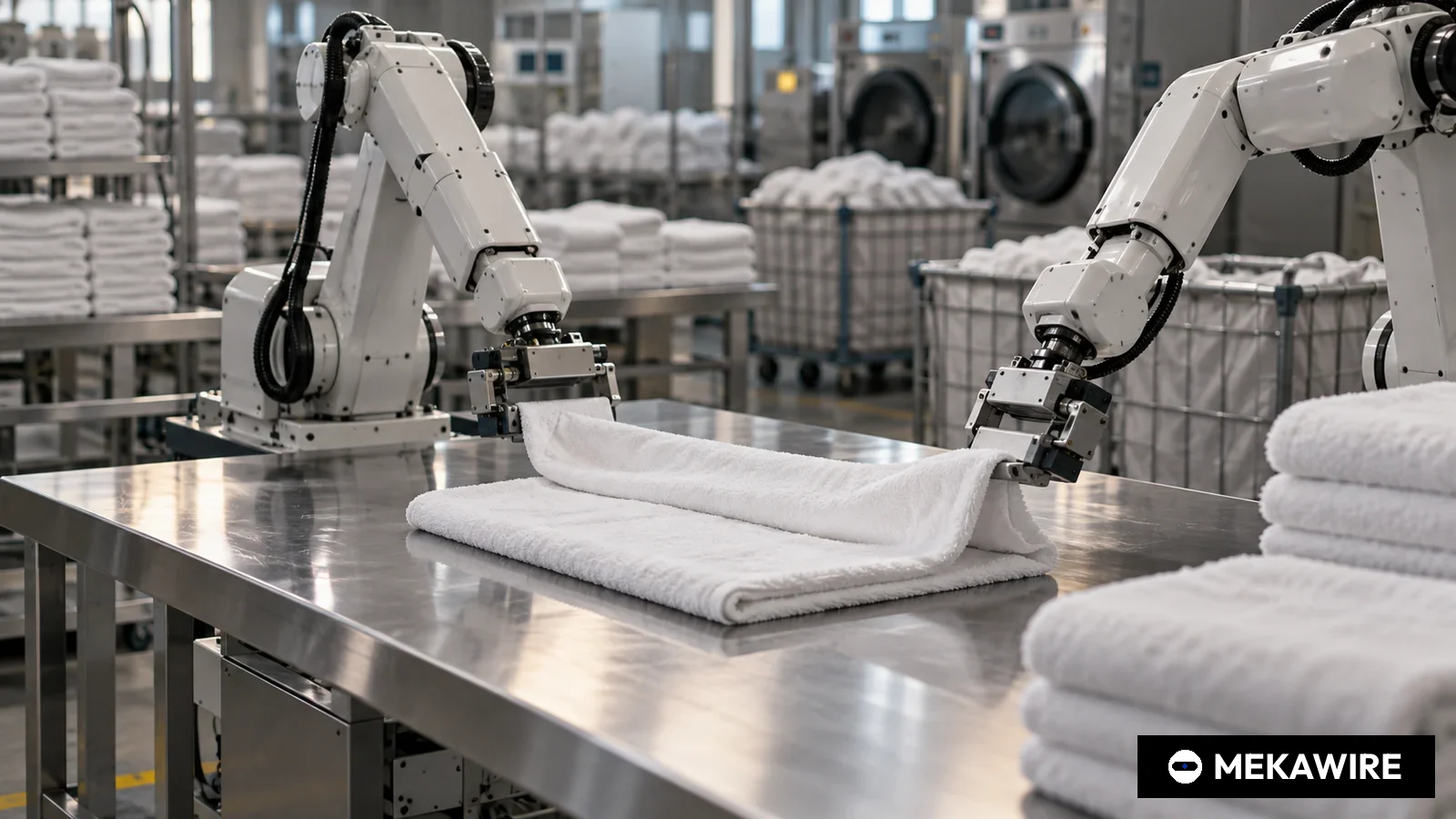
Dyna Robotics closed a US$120 million Series A on 15 September 2025, led by Robostrategy, CRV and First Round Capital with NVIDIA, Amazon, Salesforce, Samsung and LG venture arms joining, six months after a US$23.5 million seed.
The Redwood City company did not disclose a valuation; it says its DYNA-1 model already runs paying deployments in hotels, restaurants, laundromats and gyms for up to 16 hours a day.
Dyna Robotics, a Redwood City, California, start-up that sells stationary robot arms for folding and other repetitive service work, said on 15 September 2025 that it had raised US$120 million in a Series A round. The round was led by Robostrategy, CRV and First Round Capital, according to the company's press release issued at 5:00 p.m. Eastern Time that day.
Salesforce Ventures, NVentures (NVIDIA's venture capital arm), the Amazon Industrial Innovation Fund, Samsung Next and LG Technology Ventures also took part, the release said. Dyna did not disclose a valuation. The money came almost exactly six months after a US$23.5 million seed round announced on 25 March 2025 and co-led by CRV and First Round Capital, which brings Dyna's disclosed equity funding to US$143.5 million. In a post on Dyna's website, chief executive Lindon Gao wrote that the round closed as the company turned one year old.
What Dyna says it has built
Dyna's pitch rests on DYNA-1, which the company describes as a single-weight, general-purpose robot foundation model. In the Series A release Dyna said the model holds a success rate above 99% over 24 hours of non-stop operation and can be deployed in new environments without additional training data. A research page Dyna published in June 2025 gives the underlying test. DYNA-1 folded more than 850 napkins over a 24-hour autonomous run at a 99.4% task success rate with no human intervention, working at roughly 60% of human folding speed. The same page shows the model folding shirts of different fabrics and sizes and learning a cup-filling task with 0.7% of its training data in under two weeks.
The company credits much of that reliability to a reward model, a second network that scores how well each attempt went so the robot can practise, recover from mistakes and generate fresh training data on its own. In his Series A post Gao wrote that Dyna runs hundreds of model variants each week through offline and online evaluations, and that a robot's total cost of ownership has to stay below thresholds such as US$50,000 or human labour remains cheaper.
Customers and deployments
According to the release, Dyna robots work in hotels, restaurants, laundromats and gyms, and after six months of deployment they run up to 16 hours a day. The one customer Dyna has named in detail is Monster Laundry, a full-service laundry in Sacramento. In a case study dated 14 October 2025, Dyna said its towel-folding robot, which the owners nicknamed Sophy Swiftfold, folded more than 200,000 garments for 10 commercial customers over three months with a 99% quality acceptance rate. Monster Laundry raised its commercial order capacity by 25% and saw store traffic rise 15% after the robot arrived, the case study said, and it put the cost of a traditional industrial folding system at more than US$300,000.
Founders and the seed
Gao and co-founder York Yang previously built Caper AI and exited it for US$350 million, according to Dyna's seed announcement. The third co-founder, Jason Ma, is a former DeepMind research scientist whose robotics work the release said had been recognised at ICRA, CoRL and ICML. At the seed stage Dyna framed its strategy as mastering single commercial tasks on low-cost stationary arms, starting with folding and food preparation, and using the real-world data those jobs produce to improve its foundation model. In a May 2026 post, Yang wrote that Dyna's longest-running deployment had reached about 10 months of daily use.
Where it sits among robot-brain start-ups
The Series A was small next to the largest robot foundation model rounds tracked by MEKAWIRE. Figure AI announced a Series C of more than US$1 billion at a US$39 billion post-money valuation one day later, on 16 September 2025. Skild AI raised US$300 million at a US$1.5 billion valuation in its July 2024 Series A and US$1.4 billion at US$14 billion in January 2026. FieldAI announced US$405 million across two rounds in August 2025, Paris-based Genesis AI raised US$105 million in June 2025, and Generalist AI raised US$400 million in June 2026. Physical Intelligence, which raised a Series B in November 2025, is the closest rival in approach because it builds a general model rather than a humanoid body. Dyna differs from most of these companies in betting on commercial revenue from narrow tasks before generality.
- Dyna Robotics
- US
- Series A
- 120
- No data
- 2025-09-15
- Dyna Robotics
- US
- Seed
- 23.5
- No data
- 2025-03-25
- Figure AI
- US
- Series C
- 1000
- 39
- 2025-09-16
- Skild AI
- US
- Series C
- 1400
- 14
- 2026-01-14
- Skild AI
- US
- Series A
- 300
- 1.5
- 2024-07-09
- FieldAI
- US
- Two rounds combined
- 405
- No data
- 2025-08-20
- Genesis AI
- FR
- Launch round
- 105
- No data
- 2025-06-30
- Generalist AI
- US
- Growth round
- 400
- No data
- 2026-06-04
Amounts and valuations as disclosed by the companies or lead investors; — = not disclosed. Dyna Series A / seed = 120 / 23.5 = 5.1x. Physical Intelligence omitted because its Series B amount is not in our verified data.
As of Oct 1, 2026
Dyna's own disclosed operating metrics are collected below. All figures come from Dyna's releases, research page and customer case study and have not been independently audited.
- Napkin-folding task success, 24-hour autonomous run
- 99.4
- %
- 2025-06
- Napkins folded in 24 hours (minimum)
- 850
- napkins
- 2025-06
- Throughput relative to a human
- 60
- %
- 2025-09-15
- Daily operation after six months at customer sites (maximum)
- 16
- hours
- 2025-09-15
- Garments folded at Monster Laundry in three months (minimum)
- 200,000
- garments
- 2025-10-14
- Quality acceptance rate at Monster Laundry
- 99
- %
- 2025-10-14
- RoboStrategy fund fair value of Dyna Series A preferred stake
- 37.25
- US$M
- 2026-02-28
Company-reported figures from Dyna's research page (June 2025), Series A release and post (15 September 2025) and Monster Laundry case study (14 October 2025); fund value from RoboStrategy, Inc. Form N-CSRS for the period ended 28 February 2026. Implied price per share = 37,249,997 / 1,491,163 = US$24.98.
As of Oct 1, 2026
MEKAWIRE analysis
Dyna is buying its way into the robot foundation model race with revenue and uptime data rather than headline scale, and its lead investor's SEC filings give an unusually concrete view of what that position is worth.
The evidence for the thesis sits in the filings as much as the press release. RoboStrategy, Inc., an SEC-registered closed-end fund, reported in its semi-annual report for the period ended 28 February 2026 that it held 1,491,163 shares of Dyna Robotics Series A preferred stock with a fair value of US$37,249,997, about 25.5% of the fund's US$146,213,380 in net assets. That implies a per-share price of about US$24.98, and the fund said such Level 3 holdings are generally marked at the price of the most recent financing round. The filing does not give Dyna's total share count, so the valuation cannot be derived from it. On the operating side, Dyna's numbers are specific, with a 99.4% success rate over 24 hours, 16-hour working days at customer sites and a named laundry customer with 200,000 garments folded.
The strongest counter-argument is that folding napkins and towels is a narrow, forgiving task, and that a model tuned to win there may not carry over to the open-ended manipulation that larger rivals are chasing. Dyna's figures are also self-reported, with only one customer named.
Bull case. If DYNA-1 keeps climbing toward human throughput at a robot cost below US$50,000, laundries, hotels and kitchens become a large paid data engine that the humanoid companies lack, and each new site improves the shared model. A ten-month continuous deployment record would then become a moat that money alone cannot buy quickly.
Bear case. At 60% of human speed the payback case is still thin, and a US$120 million round is small against rivals raising ten times as much. If better-funded general models reach acceptable folding performance as a side effect, Dyna's task-by-task advantage could compress before it reaches scale.
Signals to watch:
- RoboStrategy's next shareholder report and Form N-PORT filings in late 2026, which will show whether the fund marks its Dyna position above US$24.98 per share.
- Any Form D or announced Series B; as of 1 October 2026 Dyna's news page listed no round after September 2025.
- New named customer case studies beyond Monster Laundry by the first quarter of 2027, especially in hotels or restaurants, and any update to the 60% human-throughput figure.
- Series A, US$120 million
- 15 September 2025, 5:00 p.m. ET
- Not disclosed
- Hotels, restaurants, laundromats, gyms; up to 16 hours a day
- US$23.5 million seed, 25 March 2025 (CRV, First Round co-led)
- Robostrategy, CRV, First Round Capital
- Salesforce Ventures, NVentures (NVIDIA), Amazon Industrial Innovation Fund, Samsung Next, LG Technology Ventures
- 99.4% success, 850+ napkins in 24 hours (June 2025)
- RoboStrategy fund: 1,491,163 Series A preferred shares, US$37.25 million fair value at 28 Feb 2026
- US$143.5 million
Why it matters
Dyna is one of the few robot foundation model companies whose commercial claims can be checked against a named customer and a public fund filing. Dyna raised its Series A on deployments that already earn money in laundries and restaurants, and it tells investors that each deployment feeds the shared model.
The investor list matters as much as the amount. NVIDIA, Amazon, Samsung and LG all sit on the cap table through their venture arms, which gives Dyna potential routes into compute, logistics and appliance or service-robot channels in the United States and Korea. None of them led, and Dyna has announced no commercial agreement with any of them.
Rival analysis
Physical Intelligence and Skild AI sell the idea of one model for many robot bodies, and Skild alone raised US$1.4 billion in its January 2026 Series C. Figure AI pairs its model with its own humanoid hardware. Genesis AI, Generalist AI and FieldAI each raised US$105 million or more in single announcements between June 2025 and June 2026. Dyna sits at the opposite end of the spectrum, with low-cost stationary arms, one task at a time, and the deployment itself as the data source.
That positioning reduces hardware risk but caps the addressable market per task. The rivalry to watch is whether a general model from a much larger competitor reaches Dyna's folding reliability before Dyna generalises beyond folding and food work.
Valuation context
Dyna did not disclose a valuation. RoboStrategy's semi-annual report shows 1,491,163 Series A preferred shares carried at US$37,249,997 on 28 February 2026, an implied US$24.98 per share. The fund says it generally marks such holdings at the most recent round price, so the figure most likely reflects the Series A price rather than a later uplift.
Without the total fully diluted share count, which neither Dyna nor the fund disclosed, the per-share price cannot be converted into a company valuation. MEKAWIRE does not estimate one. Against peers, the round size of US$120 million is about one eighth of Figure's Series C and under a tenth of Skild's Series C.
Supply-chain implications
Dyna's design depends on commodity stationary arms rather than custom humanoids, which keeps its bill of materials close to the US$50,000 total-cost-of-ownership threshold Gao set out. Its main inputs are therefore industrial arms, grippers, cameras and GPU compute for training, with NVIDIA present on the cap table through NVentures.
The model's improvement loop relies on data collected at customer sites. That makes uptime and site count, rather than factory capacity, the scaling constraint, and it means expansion depends on service and installation capability in each city.
Signals to watch
RoboStrategy's next shareholder report and quarterly N-PORT filings in late 2026 will show any change in the fund's mark on Dyna. A rise above US$24.98 a share would point to a new priced round.
On the commercial side, watch for named hotel or restaurant customers and for an update to the 60% human-throughput figure. On financing, a Form D or announced Series B would be the first since September 2025; Dyna's news page listed none as of 1 October 2026.
Analyst view
Thesis: Dyna is a credible narrow-task player whose differentiation is deployment data and uptime, and its next round will depend on proving the model generalises beyond folding.
Confidence: medium. The funding, investors and benchmark figures are confirmed on Dyna's own pages and the share position is confirmed in an SEC filing, which supports the base case. Confidence is held back because all operating metrics are self-reported, only one customer is named, and no valuation or revenue figure is public.
Questions you should be asking
How many robots and sites does Dyna operate, and what share of revenue comes from laundry versus food service? What price per robot or per month do customers pay, and how close is it to the US$50,000 ownership threshold?
Has throughput moved beyond 60% of human speed since September 2025, and does DYNA-1 really deploy in new sites without extra data at the 99% level outside folding?