Physical Intelligence raises $600 million at $5.6 billion as CapitalG leads bet on a shared robot brain
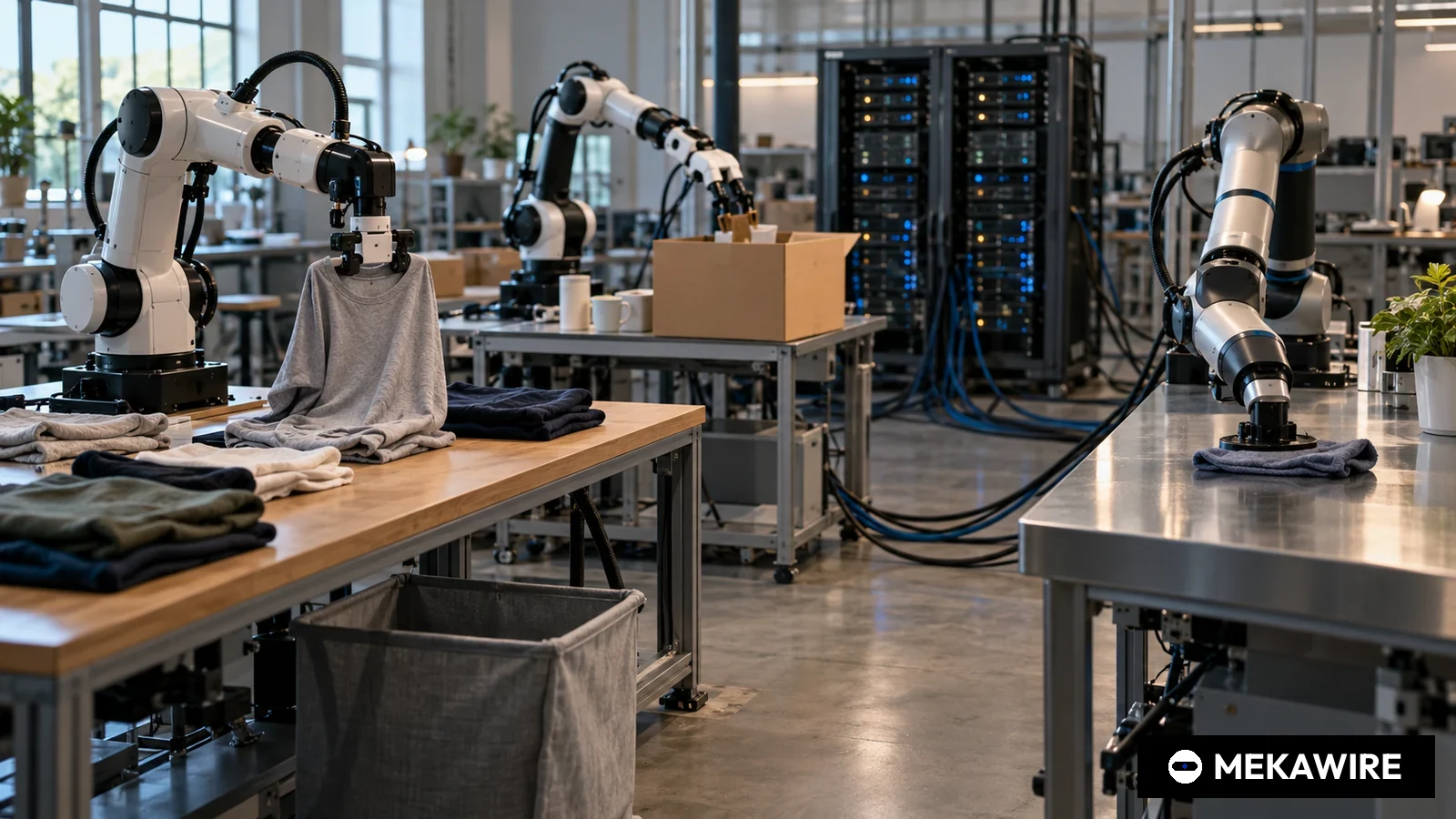
Robot foundation model developer Physical Intelligence has raised $600 million at a $5.6 billion valuation in a Series B led by Alphabet's growth fund CapitalG, according to its investors. The round followed the release of π*0.6, a model the company says more than doubles throughput on hard tasks after reinforcement learning on real robots.
Physical Intelligence, the San Francisco start-up building general-purpose AI models for robots, has raised $600 million at a $5.6 billion valuation, according to its investor Outset Capital. Alphabet's growth fund CapitalG led the round and confirmed its lead role in a note published on November 20, 2025.
Outset Capital, which describes Physical Intelligence as a portfolio company, said Lux Capital, Thrive Capital, Jeff Bezos, Index Ventures and T. Rowe Price took part alongside CapitalG. CapitalG called the financing a Series B. Neither investor disclosed how the $600 million splits between new and existing backers, whether the $5.6 billion figure is measured before or after the new money, or what the company plans to spend it on line by line.
The raise lands three days after Physical Intelligence published π*0.6 on November 17, 2025, a version of its vision-language-action model trained further with reinforcement learning on real robots. In the accompanying paper, posted to arXiv on November 18, the company's researchers describe a method called RECAP that feeds demonstrations, data the robot gathers while working and corrections from human teleoperators into one self-improvement loop. On the hardest tasks they tested, the authors say RECAP more than doubles task throughput and roughly halves the failure rate.
CapitalG's partners Jill Chase and Manmeet Gujral wrote that π*0.6 runs for hours making espresso drinks, folds unfamiliar laundry in homes it has never seen and assembles packaging boxes in working factories, with success rates above 90%. Outset Capital added that the model is already deployed commercially at a laundromat in San Francisco. Neither investor named the operator or gave fleet sizes.
The company sells no robot of its own. Its bet is on the software layer, a single policy that can be trained once on data from many machines and then run on different arms and grippers. It published its first generalist policy, π0, on October 31, 2024, and released π0 as open source on February 4, 2025. CapitalG's note names Karol Hausman as co-founder and chief executive and Lachy Groom as co-founder, and singles out the researchers Sergey Levine, Chelsea Finn, Brian Ichter and Quan Vuong and engineering leader Adnan Esmail.
The round puts Physical Intelligence among the most richly funded robot software companies in the United States, though still well behind the humanoid makers that build their own hardware. Figure AI closed a Series C of more than $1 billion at a $39 billion post-money valuation on September 16, 2025, about seven times the value investors put on Physical Intelligence. Skild AI, its closest rival in robot foundation models, last disclosed a $300 million Series A at $1.5 billion in July 2024. FieldAI announced $405 million across two rounds in August 2025, and Dyna Robotics raised a $120 million Series A in September.
- Physical Intelligence
- US
- Series B
- 600,000,000
- 5,600,000,000
- 2025-11-20
- Figure AI
- US
- Series C
- 1,000,000,000
- 39,000,000,000
- 2025-09-16
- FieldAI
- US
- Two rounds combined
- 405,000,000
- No data
- 2025-08-20
- Skild AI
- US
- Series A
- 300,000,000
- 1,500,000,000
- 2024-07-09
- Dyna Robotics
- US
- Series A
- 120,000,000
- No data
- 2025-09-15
- Genesis AI
- FR
- Launch round
- 105,000,000
- No data
- 2025-06-30
Figures as disclosed by companies or lead investors, not estimated. Physical Intelligence valuation as stated by investor Outset Capital without pre/post basis; Figure and Skild AI are post-money. FieldAI figure combines two rounds. MEKAWIRE calculation: Figure valuation / Physical Intelligence valuation = 39 / 5.6 = 7.0x.
As of Oct 1, 2026
The technology at stake is easy to describe and hard to make work. A vision-language-action model takes camera images and a written instruction and outputs motor commands. Training on demonstrations alone gives a robot that copies people but stalls when something unexpected happens. Reinforcement learning on deployed robots lets the model improve from its own successes and mistakes, which is what π*0.6 claims to do at a scale useful to a business. Throughput matters because a robot that is reliable but slow does not pay back its cost on a factory floor or in a laundromat.
For industrial buyers in the US and Europe, the signal is that capital is flowing to whoever can make generic robot arms productive without months of custom programming. That threatens the integrator model that dominates automation sales today and favours hardware makers willing to open their machines to an outside brain. It also raises the price of talent, since a handful of research groups now compete for the same few hundred people who have trained these models on real robots.
The risks are plain. Physical Intelligence has disclosed no revenue, no customer count and no robot fleet numbers. Its strongest performance claims come from its own paper and from investors with a stake in the outcome. Model companies also depend on hardware partners for data and deployment, and a humanoid maker with its own model, such as Figure, can keep that data in house.
MEKAWIRE analysis
CapitalG's lead turns Physical Intelligence into the reference bet that robot intelligence can be sold separately from robot bodies.
The evidence is in the sequencing. A model release showing reinforcement learning gains on real tasks came three days before the round was confirmed, and the investor list mixes a Big Tech growth fund, a public market manager in T. Rowe Price and Jeff Bezos personally. That combination usually signals investors positioning for a later private round or listing rather than a pure research bet.
The strongest counter-argument is that the valuation leans on demonstrations, not sales. Figure's $39 billion rests on the promise of selling complete robots, while Physical Intelligence must persuade hardware makers to hand over their most valuable asset, their operating data. If the large humanoid builders keep their models proprietary, the open market for a shared robot brain could shrink to smaller arm makers with thin margins.
Bull case. RECAP style training lets customers improve robots in the field, so each deployment makes the model better and harder to copy. Within two years Physical Intelligence licenses its policy across several arm makers and logistics operators, and the $5.6 billion mark looks cheap next to humanoid valuations.
Bear case. Gains shown on espresso, laundry and boxes do not carry over to the messy long tail of industrial work, and integration costs stay high. Hardware makers build or buy their own models, leaving Physical Intelligence with research prestige and a high cash burn.
Signals to watch.
- Any first named commercial customer or hardware licensing deal announced by Physical Intelligence through mid-2026.
- Skild AI's next funding round, which will show whether investors price the two model companies alike.
- Whether Physical Intelligence opens π*0.6 or later models to outside developers in 2026, as it did with π0 in February 2025.
- Series B, confirmed by CapitalG on November 20, 2025
- $600 million (Outset Capital)
- $5.6 billion (Outset Capital; pre or post not specified)
- Karol Hausman, co-founder and CEO; Lachy Groom, co-founder
- RECAP more than doubles throughput and roughly halves failure rate on the hardest tasks (arXiv 2511.14759)
- π*0.6, published November 17, 2025
- Lux Capital, Thrive Capital, Jeff Bezos, Index Ventures, T. Rowe Price
- CapitalG, Alphabet's independent growth fund
Why it matters
The round is the largest disclosed financing for a company that makes robot models but no robots. Until now the biggest cheques in physical AI went to humanoid makers such as Figure, whose valuations rest on owning the full stack. A $600 million raise for a pure model developer, led by a fund attached to Alphabet, tells hardware makers that investors expect a separate, licensable intelligence layer to exist.
It also changes the bargaining position of mid-sized arm makers and integrators. If a general policy can be adapted to a new machine with modest data, the value in an automation project shifts from custom programming toward data collection and model access. That is the shift Physical Intelligence is being paid to accelerate.
Rival analysis
Skild AI is the most direct rival, also selling a general robot brain across hardware, and last disclosed a $300 million Series A at $1.5 billion in July 2024. On disclosed numbers Physical Intelligence now carries a valuation about 3.7 times Skild's last mark, a MEKAWIRE calculation that ignores any undisclosed Skild round since. Google DeepMind's Gemini Robotics and NVIDIA's GR00T models compete from inside platform companies with far larger compute budgets.
Vertically integrated humanoid makers are the other camp. Figure trains its own Helix model and raised more than $1 billion at $39 billion in September 2025. Smaller US entrants such as Dyna Robotics ($120 million Series A) pursue narrower commercial tasks with their own hardware, and Europe's Genesis AI raised $105 million in 2025 for a similar universal model ambition.
Valuation context
Outset Capital gives $5.6 billion without saying whether it is pre or post money. Even read as post-money, the new money would equal roughly 11% of the company, a MEKAWIRE calculation of 0.6 / 5.6. That is a modest dilution for a round of this size and implies strong demand for allocation.
The valuation sits far below Figure's $39 billion but well above any disclosed mark for a robot software company in Europe. Without revenue disclosure, the price is a multiple of talent, research output and expected licensing reach, which makes it sensitive to the next model release and to any first commercial contract.
Supply-chain implications
Physical Intelligence relies on third-party arms, grippers and cameras, which makes low-cost hardware suppliers beneficiaries if its models succeed. Its training also depends on large GPU clusters and on teleoperation data, so spending will flow to cloud compute and to data collection operations.
For component suppliers in Europe and Asia, a hardware-agnostic model widens the market for standard arms and sensors, since buyers can swap hardware without retraining from zero. For integrators, the risk is commoditisation of their programming services.
Signals to watch
First, any named customer or licensing agreement with an arm maker, which would turn research claims into revenue evidence. Second, follow-up publications extending RECAP to new tasks, including the December 16, 2025 post on human-to-robot transfer. Third, the next rounds at Skild AI and Figure, which will set the relative price of model-only versus full-stack companies.
Also watch hiring, especially in Europe, and whether the company opens newer models after making π0 open source in February 2025.
Analyst view
Thesis: CapitalG's lead turns Physical Intelligence into the reference asset for robot intelligence sold separately from hardware. Confidence: medium.
The reasons for medium rather than high are the absence of any disclosed revenue or customer count, performance claims sourced to the company's own paper and to investors, and a still unproven willingness by hardware makers to share data. The reasons it is not low are the quality of the research team named by CapitalG, the documented RECAP gains, and the breadth of the investor base, which includes a public market manager.
Questions you should be asking
How much of the $600 million came from new investors versus existing ones? Is $5.6 billion pre or post money? Who operates the San Francisco laundromat deployment Outset Capital mentions, and how many robots run there? Which hardware partners supply the data behind π*0.6? Will the company license models commercially in 2026 or stay focused on research releases?