Nabtesco explained: RV reducer sales up 23.6%, margin doubles to 10.6%, and its plants now run 21% faster
Nabtesco, maker of the RV precision reducers in most medium and large industrial robot joints, lifted component-segment sales 23.6% to ¥45.5 billion in the first half of 2026 and doubled its margin to 10.6%, then raised its full-year reducer sales plan to ¥94.6 billion.
MEKAWIRE's reading of the company's plant data shows output rising about 21% in a year, driven by Chinese and Korean car-plant spending, while Europe stays flat and the RV mini for physical-AI robots has only just started shipping.
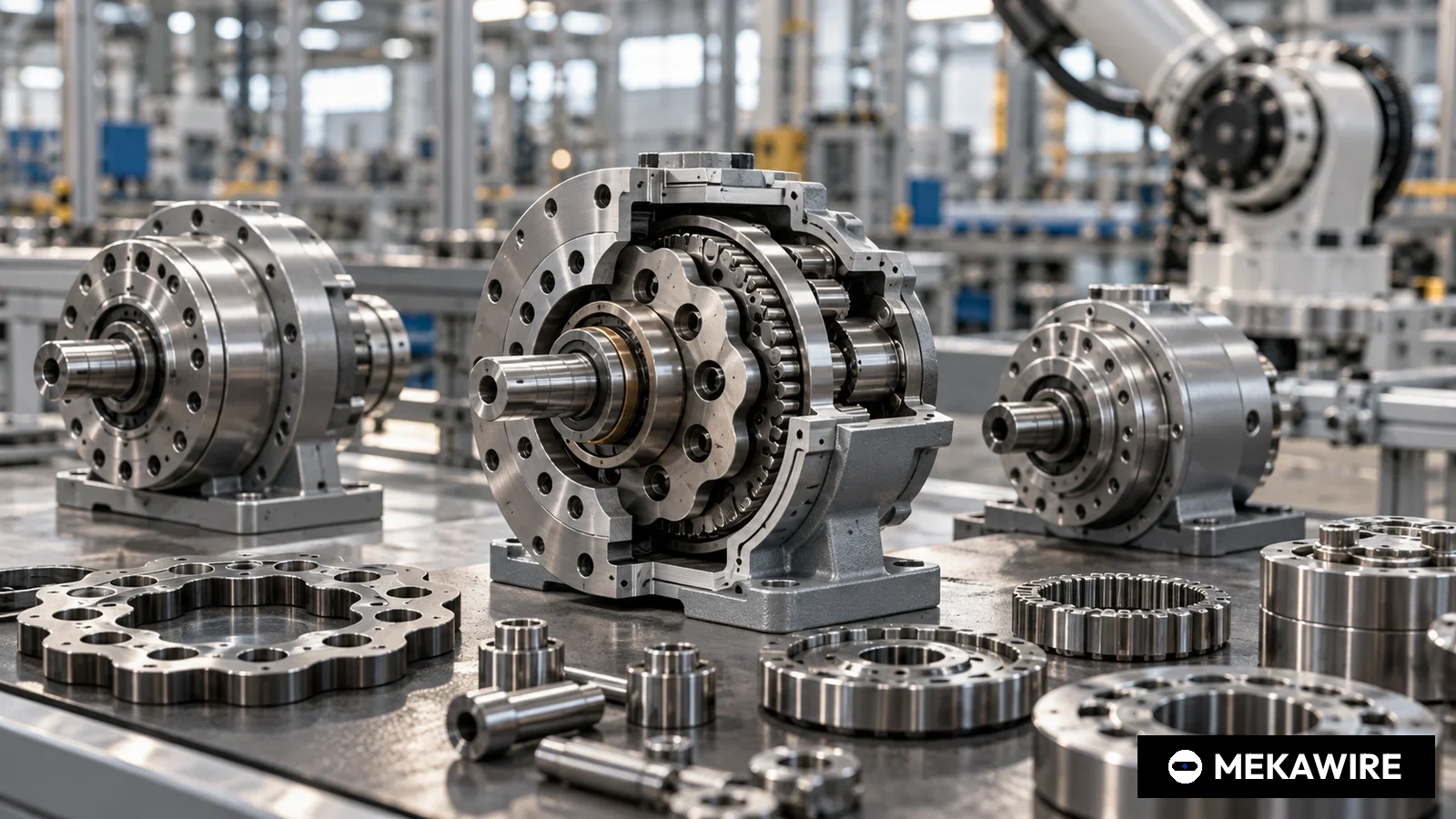
Nabtesco makes the RV precision reducer, the cycloidal gearbox that sits in the shoulders, elbows and bases of most medium and large industrial robots, and by its own estimate it holds about 60% of that joint market. In the first half of 2026 its component solutions segment, which is almost entirely reducers, grew sales 23.6% to ¥45.5 billion and lifted operating profit from ¥1.9 billion to ¥4.8 billion, the company said in its Aug 5 results briefing. The margin doubled from 5.0% to 10.6%.
The obvious reading is that the robot cycle has turned. The more useful question is what kind of turn it is, because the answer decides whether Nabtesco's reducer margin can get back to the mid-teens it earned before 2022 or stalls around 10%. The company's own plant data, regional commentary and revised plan let us answer that more precisely than the headline growth rate does.
The numbers Nabtesco reported for the half
Precision reduction gear sales rose to ¥45.1 billion from ¥36.5 billion. Reducer orders grew 11% from the first quarter and 23% from a year earlier in the second quarter, after a 4% sequential dip in the first. On July 31 the company raised its full-year reducer sales plan to ¥94.6 billion from ¥88.2 billion, 20.4% above the ¥78.6 billion of 2025, and its segment profit plan to ¥9.7 billion from ¥7.0 billion, a 10.2% margin. For the group, which also sells train, aircraft and marine equipment and automatic doors, first-half sales rose 17% to ¥167.4 billion and operating profit 72% to ¥15.8 billion.
- FY2025 (Jan to Dec)
- 78.6
- 79.3
- 5.42
- 6.8%
- H1 2025
- 36.5
- 36.8
- 1.9
- 5.0%
- H1 2026
- 45.1
- 45.5
- 4.8
- 10.6%
- FY2026 plan, Apr 30
- 88.2
- 88.6
- 7.0
- 7.9%
- FY2026 plan, Jul 31
- 94.6
- 95.3
- 9.7
- 10.2%
- Implied H2 2026
- 49.5
- 49.8
- 4.9
- 9.8%
Company figures from the FY2025 and Q2 FY2026 results briefings. Implied H2 = July 31 full-year plan minus H1 result; margin = operating profit / sales (MEKAWIRE calculations from rounded billions).
As of Oct 18, 2026
The company attributed the robot demand to capital spending by Chinese and Korean car makers, with machine tools and chip-making equipment recovering on the non-robot side. It described Japan as stable, expects a partial recovery among some US car makers and said demand in Europe remains stagnant. It also credited price pass-through, and noted that some expenses had slipped into later periods.
What the plants say that the income statement does not
Nabtesco discloses the capacity and utilisation of its three reducer plants, which turns the recovery into a physical quantity. Tsu in Japan, with 890,000 units a year, ran at 85% in the second quarter against 65% a year earlier. Changzhou in China, with 170,000 units, ran at 100% against 110%, after falling to 90% in the first quarter. The 90,000-unit Hamamatsu plant, opened in August 2024, is only described as gradually expanding.
- Tsu, Japan
- 890
- 65%
- 85%
- 579
- 757
- Changzhou, China
- 170
- 110%
- 100%
- 187
- 170
- Hamamatsu, Japan
- 90
- not disclosed
- not disclosed
- n/a
- n/a
- Tsu + Changzhou
- 1,060
- No data
- No data
- 766
- 927 (+21.0%)
Capacity and utilisation from Nabtesco's Q2 FY2026 briefing (utilisation assumes 20 working days a month and three shifts). Implied output rate = capacity x utilisation (MEKAWIRE calculation); it is an annualised run rate, not reported shipments.
As of Oct 18, 2026
Multiplying capacity by utilisation gives an implied annualised output rate. For Tsu and Changzhou together it rose from about 766,000 to 927,000 units, or 21.0%, close to the 23% rise in orders. Nearly all of the extra volume came from Tsu. That matters for margins, because Tsu is by far the largest plant, so each extra unit there spreads fixed cost that is already in place, while Changzhou was already above its nominal capacity a year ago.
MEKAWIRE analysis: a volume recovery, not yet a new growth market
Nabtesco's margin rebound is operating leverage from Chinese and Korean car-plant spending refilling idle capacity at its main Japanese plant; the physical-AI story has not reached its numbers yet.
The evidence lines up. Incremental margin in the half was 33.3%, meaning each extra ¥100 of segment sales added about ¥33 of profit (¥2.9 billion of extra profit on ¥8.7 billion of extra sales). The demand drivers the company names are car-plant automation in China and Korea, the classic market for large RV-equipped robots. Sales in China across the group rose 24.7% to ¥24.7 billion, helped by a yuan 12.6% stronger against the yen on average. The RV mini, the compact reducer Nabtesco aims at cobots and humanoid joints, only began customer deliveries in the second half.
The plan also implies caution. Subtracting the first half from the July plan leaves second-half reducer sales of ¥49.5 billion, 9.8% above the first half, but a segment margin of 9.8%, below the first half's 10.6%. Part of that is the delayed expenses, and part is a budget that assumes the yen at ¥21.50 per yuan in the second half against ¥23.05 in the first. Before the hydraulics business was carved out, the segment earned 17.9% in 2017 and 11.3% in 2022, so 10% is a recovery, not a peak.
The strongest counter-argument is that the operating leverage has further to run. Tsu still has 15 points of utilisation headroom and Hamamatsu is mostly idle, so if orders keep growing at 20% a year, volume could lift margins without any new plant. In the bull case, Korean and Chinese car makers keep spending, the US recovery the company expects arrives, and margins pass 12% in 2027. In the bear case, Chinese EV capex, the main driver, slows after 2026, Europe stays flat and the yen strengthens, leaving the segment near 8% to 9%.
How Nabtesco compares with Harmonic Drive and Leaderdrive
- Nabtesco CMP (JP)
- Jan to Jun 2026
- ¥45.5bn
- +23.6%
- Operating margin 10.6%
- Q2 reducer orders +23%
- Harmonic Drive Systems (JP)
- Apr to Jun 2026
- ¥16.68bn
- +23.6%
- Operating margin 11.0%
- +55.7%
- Leaderdrive (CN)
- Jan to Jun 2026
- 348.55m yuan
- +38.64%
- Net margin 20.1%
- n/a
Verified MEKAWIRE rows from company filings (Nabtesco Q2 briefing; HDS Q1 tanshin, Aug 7; Leaderdrive H1 data from its sponsor filing). Disclosed figures, not estimates; periods and profit measures differ. Leaderdrive H1 revenue at Nabtesco's H1 average rate of ¥23.05 per yuan = about ¥8.0bn, 17.8% of Nabtesco's H1 reducer sales (MEKAWIRE calculation).
As of Oct 18, 2026
Harmonic Drive Systems, which makes the strain-wave gears used in smaller robot joints, grew sales by the same 23.6% in its April to June quarter at an 11.0% operating margin, but its orders rose 55.7%, more than twice Nabtesco's pace, fed by surgical, chip-tool and robot demand at once. China's Leaderdrive grew revenue 38.64% in the first half with a 20.1% net margin; converted at Nabtesco's own average rate, its half-year revenue equals about 17.8% of Nabtesco's reducer sales. Nabtesco remains the largest of the three by revenue, and its plan of ¥94.6 billion in reducer sales is 127% of HDS's entire group forecast of ¥74.5 billion for the year to March 2027.
What to watch
In its next quarterly report, for July to September, the first signal is whether reducer orders keep rising sequentially and whether Tsu utilisation passes 85%. The second is the first disclosure of RV mini volumes or named customers, which would show whether the physical-AI demand the company cites in its plan is real business. The third is any capacity decision at Changzhou, back at 100%: a local expansion would say Nabtesco expects Chinese robot makers to keep buying Japanese-designed reducers rather than switching to domestic suppliers.
- Deliveries to customers started in the second half of 2026
- 1.15 million units a year: Tsu 890,000, Changzhou 170,000, Hamamatsu 90,000
- Sales ¥167.4bn (+17%), operating profit ¥15.8bn (+72%), margin 9.5%
- Tsu 85% (65% a year earlier), Changzhou 100% (110%)
- +11% quarter on quarter, +23% year on year
- Sales ¥95.3bn, operating profit ¥9.7bn, margin 10.2%
- ¥45.1bn in H1 2026 (¥36.5bn); full-year plan raised to ¥94.6bn from ¥88.2bn (2025: ¥78.6bn)
- Sales ¥45.5bn (+23.6%), operating profit ¥4.8bn (from ¥1.9bn), margin 10.6% (5.0%)
- China and Korea car-maker capex recovered; Japan stable; US partial recovery expected; Europe stagnant
Why it matters
RV reducers are the single most concentrated component in large industrial robots, and Nabtesco's own estimate puts its share of medium and large robot joints at about 60%. Its order book is therefore one of the earliest public readings of industrial robot production, months before robot makers' own shipment data.
The first half of 2026 shows that reading turning clearly up, but driven by car-plant capex in China and Korea rather than by new robot categories. For investors this separates two stories that are often blended: a cyclical recovery that is visible in Nabtesco's plants now, and a physical-AI demand story that has not yet appeared in its disclosed numbers.
Rival analysis
Harmonic Drive Systems competes in strain-wave gears for wrists and smaller arms rather than in RV reducers, so the two are complements in most robots. HDS grew at the same 23.6% in its latest quarter with stronger orders (+55.7%) and a slightly higher margin (11.0%), because its demand is spread over surgical robots, semiconductor tools and robots; Nabtesco's is concentrated in large robots and therefore more cyclical.
Leaderdrive is the Chinese challenger, profitable at a 20.1% net margin and growing 38.64%, with half-year revenue equal to about 17.8% of Nabtesco's reducer sales. Its growth rate is the main reason the market questions whether Chinese robot makers will keep paying for Japanese reducers; Nabtesco's Changzhou plant, at 100% utilisation, is its local answer.
Valuation context
This piece uses only disclosed results, not market prices. On those, the segment's earnings power is recovering from a trough: margin 3.9% in 2024, 6.8% in 2025, 10.6% in the first half of 2026 and 10.2% planned for the year, against 11.3% in 2022 and 17.9% in 2017 as then reported (with hydraulics).
The segment contributes about 30% of group operating profit (4.8 of 15.8 in the half, 9.7 of 32.6 in the plan), so the reducer cycle moves the group's earnings far more than its share of sales suggests. Any valuation that pays for a return to mid-teens margins is paying for a second leg of the cycle that the company's own second-half plan does not yet assume.
Supply-chain implications
Capacity is 1.15 million units a year: 890,000 at Tsu and 90,000 at Hamamatsu in Japan, 170,000 at Changzhou in China. Changzhou has been at or above full utilisation for most of the past five quarters, so Chinese customers who want local supply already compete for a fixed pool, and incremental Chinese demand is served from Japan.
Currency is the second exposure. Nabtesco states that each one-yen move in the yuan shifts first-half sales by about ¥802 million and operating profit by ¥119 million, the largest sensitivity of any currency it lists. Its second-half plan assumes ¥21.50 per yuan against a first-half average of ¥23.05.
Signals to watch
Third-quarter (July to September) results: sequential reducer order growth and Tsu utilisation above 85% would confirm the volume thesis. A margin below 9% would suggest the delayed expenses and currency are eating the leverage.
First RV mini volume or customer disclosure, possibly with full-year results early next year, would show whether physical-AI demand is material. A Changzhou expansion announcement would signal confidence that Chinese robot makers stay with Japanese reducers.
Analyst view
Thesis: Nabtesco's 2026 rebound is a classic large-robot cycle refilling Tsu, with real operating leverage still to come if orders keep growing, but no evidence yet of a structural new market. Confidence: medium. The plant and order data are unusually transparent and consistent with each other, but the second-half plan is conservative for reasons (delayed costs, currency) that could reverse either way.
What would change our view: disclosed RV mini volumes above a few percent of reducer sales, or a sustained recovery in European and US robot orders, would make the case for a broader upcycle; a Chinese EV capex slowdown in Nabtesco's commentary would make 2026 look like the peak.
Questions you should be asking
How many RV mini units shipped in the third quarter, and to which kinds of customers: cobots, humanoids or conventional robots?
What utilisation at Tsu triggers a decision to load Hamamatsu or expand Changzhou, and how much of the 2026 margin gain came from price pass-through rather than volume?
How much of first-half Chinese reducer demand came from domestic Chinese robot makers rather than from foreign makers' Chinese plants, and is that share changing as Leaderdrive grows?