DoorDash unveils Dot, an in-house road and sidewalk delivery robot, and an AI dispatcher to run it alongside Dashers
DoorDash on September 30, 2025 introduced Dot, an all-electric delivery robot built by DoorDash Labs that travels up to 20 mph on bike lanes, roads, sidewalks and driveways. Early access starts in Tempe and Mesa, Arizona, with an Autonomous Delivery Platform that assigns each order to a Dasher, Dot, drone or sidewalk robot.
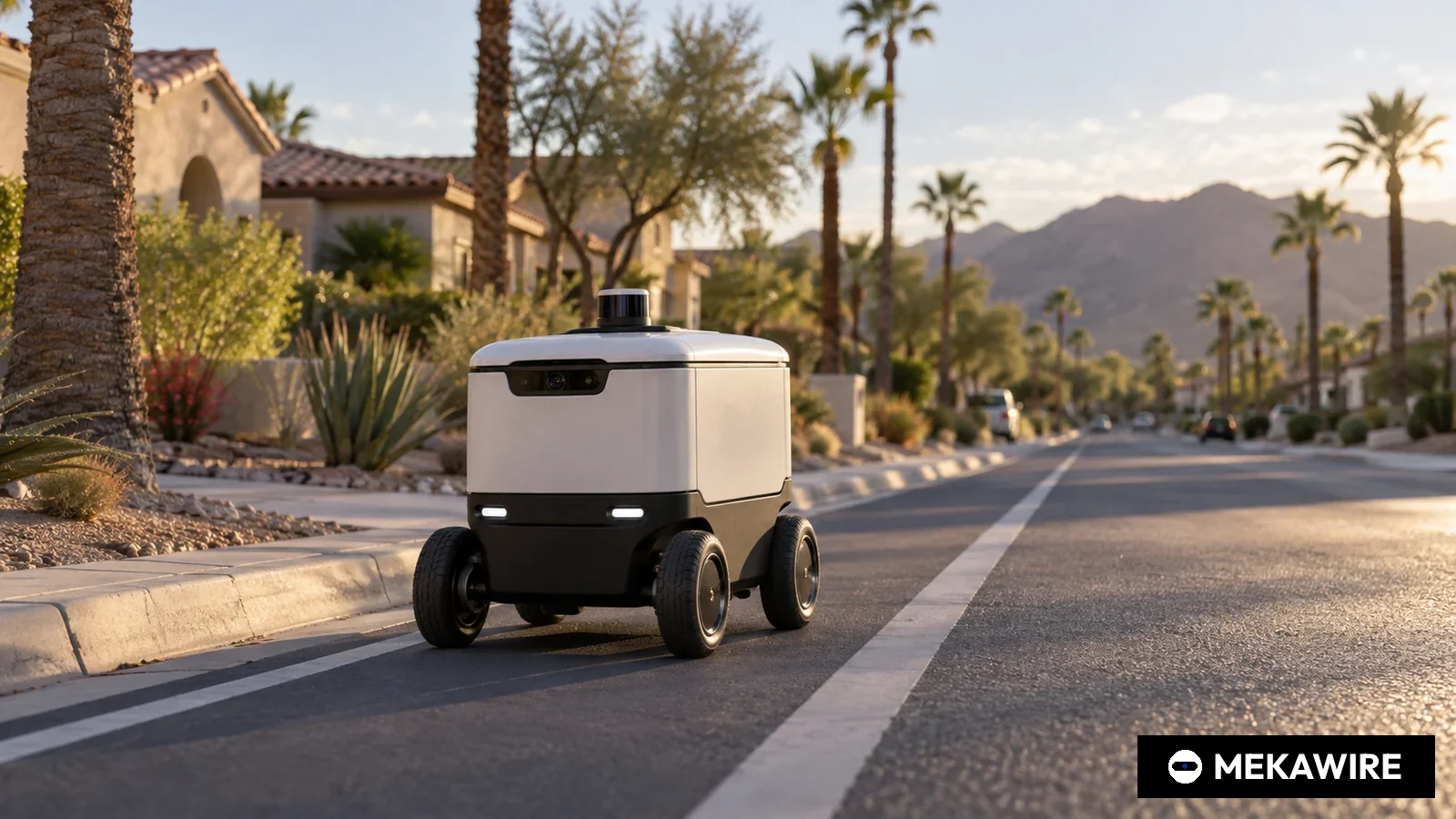
DoorDash on September 30, 2025 unveiled Dot, an all-electric autonomous delivery robot developed entirely in-house by its DoorDash Labs unit, and said it would put the machine into commercial service through an early access program in Tempe and Mesa, Arizona, in the greater Phoenix metro area. The San Francisco company, whose shares trade on Nasdaq under the ticker DASH, presented the robot together with an Autonomous Delivery Platform that it said will choose, for every order, whether a human courier, a Dot, a drone or a sidewalk robot makes the trip.
According to DoorDash's announcement, Dot reaches speeds of up to 20 mph, roughly 32 km/h, and is one-tenth the size of a car while remaining small enough to pass through doorways and driveways. The company called it the first commercial autonomous robot built to travel on bike lanes, roads, sidewalks and driveways. It did not publish payload capacity, battery range, exact dimensions, weight, fleet size or a breakdown of the sensor suite it referred to.
The software layer may matter as much as the hardware. DoorDash described the Autonomous Delivery Platform as an AI dispatcher that matches each order with a delivery method on the basis of speed, cost, location and experience, and said it coordinates Dashers, Dot robots, drones and sidewalk robots in real time across its network. The company added that the platform draws on strategic partnerships with autonomous technology providers, without naming them in the release.
DoorDash was careful to frame the robot as a complement to its courier base. It said Dashers will continue to complete the vast majority of its millions of daily deliveries, and that autonomy should let them concentrate on higher-value orders that call for human judgment and care. Stanley Tang, co-founder and head of DoorDash Labs, said the hard part had been making the robot reliable and efficient enough to serve local merchants and consumers. Ashu Rege, vice president and head of autonomy at DoorDash Labs, said delivery autonomy had to be rethought from the ground up.
The Arizona launch came with municipal backing. Mesa Mayor Mark Freeman was quoted in the release as saying his city is helping to shape the future of local delivery rather than merely taking part in it. DoorDash did not give a timetable for moving beyond the early access phase, the number of robots involved or the merchants taking part.
DoorDash was founded in 2013 and says it has expanded to more than 30 countries. Its core business is a marketplace that dispatches independent couriers for restaurant, grocery and retail orders. Building a vehicle of its own moves the company one step down the stack, from buying delivery capacity to manufacturing part of it.
Dot enters a segment where specialists have raised substantial capital. Starship Technologies, founded in 2014, announced a $90 million round in February 2024 and a $50 million Series C on October 15, 2025. Coco Robotics, founded in 2020, announced $80 million on June 11, 2025. Nasdaq-listed Serve Robotics raised $80 million through a registered direct offering in January 2025 and announced a further $100 million offering on October 10, 2025. Nuro, founded in 2016, announced a $203 million Series E on August 21, 2025. Avride, founded in 2017, announced on October 22, 2025 a strategic investment and other commitments of up to $375 million backed by Uber and Nebius.
- DoorDash
- 2013
- Public company (NASDAQ: DASH)
- No data
- No data
- No data
- Serve Robotics
- No data
- Registered direct offering
- 100,000,000
- 2025-10-10
- 371,000,000
- Starship Technologies
- 2014
- Series C
- 50,000,000
- 2025-10-15
- 222,200,000
- Coco Robotics
- 2020
- Strategic financing
- 80,000,000
- 2025-06-11
- 80,000,000
- Nuro
- 2016
- Series E
- 203,000,000
- 2025-08-21
- 1,303,000,000
- Avride
- 2017
- Strategic investment
- No data
- 2025-10-22
- No data
Figures as disclosed by each company and held in MEKAWIRE verified data; nothing estimated. Sum of listed rounds = arithmetic sum of the rounds recorded in our dataset, not lifetime funding. Avride's announcement cites commitments of up to $375 million but no single round amount, so it is left blank. Some rounds were announced after Dot's unveiling on 2025-09-30.
As of Oct 1, 2026
The engineering bet is about where the robot drives. Sidewalk robots move at walking pace among pedestrians, which limits their radius, while full-size autonomous cars carry far more than a single meal and cost far more per trip. A vehicle one-tenth the size of a car that can use bike lanes and roads at up to 20 mph and then roll up a driveway is designed to stretch the range of a single robot trip without the cost profile of a car. The dispatcher then treats each mode as a resource with its own speed and cost, which is how DoorDash intends to decide when a robot is worth sending.
For the wider delivery industry the announcement signals that a marketplace handling millions of deliveries a day no longer wants to rely only on third-party robot suppliers. Platforms control demand, and a platform that owns both demand and a vehicle can tune hardware to its own order data. That changes the commercial position of independent robot makers, which until now have counted delivery marketplaces among their main customers.
Much remains unproven. DoorDash has not disclosed safety data, operating hours, unit costs or the cargo Dot can carry. Rules for small vehicles that move between sidewalks, bike lanes and roads differ by state and city, and an early access program in two Arizona cities says little about performance in snow, dense downtowns or older suburbs without bike lanes. Courier groups may also scrutinize how the dispatcher allocates orders between robots and people.
The next signals will come from DoorDash's quarterly shareholder communications, from any expansion of the Tempe and Mesa program to more of the Phoenix area, and from whether the company names the autonomy partners that feed its platform.
MEKAWIRE analysis
DoorDash's real asset is the dispatcher, and Dot is the lever that lets it set the price other robot makers must beat.
The evidence sits in the release itself. DoorDash gave detailed language about how the Autonomous Delivery Platform weighs speed, cost, location and experience, but withheld almost every hardware metric that would let rivals benchmark Dot. A marketplace that already handles millions of daily deliveries can route a small share of orders to its own robot, learn the true cost per trip and use that number in negotiations with outside suppliers such as those it calls strategic partners.
The strongest counter-argument is that hardware is expensive and slow to scale, and specialists such as Starship, Serve, Coco, Nuro and Avride have together disclosed well over $1 billion in the financing rounds listed in the table. A first-generation in-house robot may underperform, and a marketplace may conclude it is cheaper to keep buying capacity.
Bull case: Dot's road-and-sidewalk design lets DoorDash serve suburban trips that sidewalk robots cannot reach, and the dispatcher lifts courier earnings per hour by moving short, low-value orders to robots. Within a few years the company could own a meaningful slice of its own last-mile capacity in warm-climate metros.
Bear case: regulatory friction across cities, vandalism and weather keep Dot confined to pilot zones, while capital spent on hardware weighs on margins. Partners grow wary of supplying a platform that also competes with them.
Signals to watch:
- Q4 2025: whether DoorDash discloses Dot fleet size, delivery counts or unit costs in its shareholder letter.
- First half of 2026: expansion of the early access program beyond Tempe and Mesa, and any second metro.
- During 2026: whether DoorDash names the autonomy partners connected to the Autonomous Delivery Platform and how many orders flow to them.
- One-tenth the size of a car; fits doorways and driveways
- NASDAQ: DASH
- Dot, all-electric autonomous delivery robot
- September 30, 2025 (dateline San Francisco)
- DoorDash Labs, developed entirely in-house
- Up to 20 mph (about 32 km/h)
- Early access program in Tempe and Mesa, Arizona (greater Phoenix)
- Payload, range, dimensions, fleet size, sensor details, expansion timeline
- Autonomous Delivery Platform matching orders to Dashers, Dot, drones or sidewalk robots
- Bike lanes, roads, sidewalks and driveways
Why it matters
DoorDash says Dot was developed entirely in-house by DoorDash Labs, which puts the company in the business of designing a vehicle rather than only contracting delivery capacity. The same release says the dispatcher also relies on strategic partnerships with autonomy providers, so in-house hardware and outside suppliers will run side by side. Owning a vehicle gives it cost data it controls, and that data feeds directly into the dispatcher it unveiled the same day.
The pairing matters because order allocation is where a marketplace makes or loses money. If the Autonomous Delivery Platform can route even a small share of short trips to robots at a lower cost than a courier payout, the effect on contribution margin compounds across millions of daily deliveries. DoorDash's own wording, that Dashers will keep doing the vast majority of deliveries, sets expectations that the robot share will stay small for now.
Rival analysis
The specialists are financed very differently. Starship (founded 2014) has disclosed five rounds in our verified data totalling $222.2 million, and Coco (founded 2020) announced $80 million on June 11, 2025. Serve Robotics, a Nasdaq-listed company, has repeatedly tapped equity markets, raising $371 million across the seven offerings in our verified data. Nuro (founded 2016) disclosed a $203 million Series E on August 21, 2025. Avride (founded 2017) announced commitments of up to $375 million backed by Uber and Nebius on October 22, 2025.
Dot sits between these camps, using roads and bike lanes for distance and sidewalks and driveways for the last metres. Its competitive edge is demand: none of the specialists controls a consumer marketplace of DoorDash's size. Its weakness is that it starts with no public operating record, and DoorDash has disclosed no delivery counts against which to judge it.
Valuation context
DoorDash is a public company and did not attach a capital figure to Dot or DoorDash Labs, so no investment number can be assigned to the program. The relevant comparison is with the specialists' financing: the rounds in our verified data add up to $1.303 billion for Nuro (Series C to E), $371 million for Serve and $222.2 million for Starship.
For robot makers that hoped to sell capacity to DoorDash, Dot is a pricing signal. A buyer with an internal alternative negotiates differently, and investors in delivery robot companies are likely to ask how dependent each is on marketplace customers.
Supply-chain implications
DoorDash did not name component suppliers, contract manufacturers or the composition of the sensor suite it mentioned. That leaves open whether Dot uses lidar, cameras, radar or a combination, and where it is assembled.
The all-electric design and car-fraction size point to a bill of materials closer to a light electric vehicle than to a sidewalk robot, with batteries, motors and compute as the main cost items. Where those parts come from will shape the cost of any US scale-up, and DoorDash has not said how it will source them.
Signals to watch
The first concrete metric to watch is any disclosure of Dot delivery volume or fleet size in DoorDash's quarterly shareholder letters from Q4 2025 onward. Absent numbers, the early access label suggests a small fleet.
The second is geography. A move beyond Tempe and Mesa within the Phoenix area during the first half of 2026 would show the operating model works; a second metro would show it travels. The third is partner disclosure for the Autonomous Delivery Platform, which would reveal how much of DoorDash's autonomy volume runs on outside hardware.
Analyst view
Thesis: Dot is primarily a strategic instrument that strengthens DoorDash's hand with autonomy suppliers and regulators, and only secondarily a volume business in the near term. Confidence: medium. The announcement contains strong product claims (speed, operating surfaces, in-house development) and a clear dispatcher concept, but none of the operational numbers that would allow a cost model.
Confidence would rise to high with disclosure of deliveries per robot per day or cost per trip. It would fall if the program stays limited to Tempe and Mesa through 2026, which would suggest technical or regulatory obstacles larger than the release implies.
Questions you should be asking
What is Dot's payload in weight and number of orders, and what range does a single charge provide?
Which autonomy partners are already connected to the Autonomous Delivery Platform, and on what commercial terms? How will DoorDash report the share of orders routed to robots, and how will that affect courier earnings in the pilot cities? Which state and municipal permits govern Dot's movement between sidewalks, bike lanes and roads in Arizona?