Generalist AI's GEN-0 claims robotics' first scaling laws, trained on 270,000 hours of real-world manipulation data
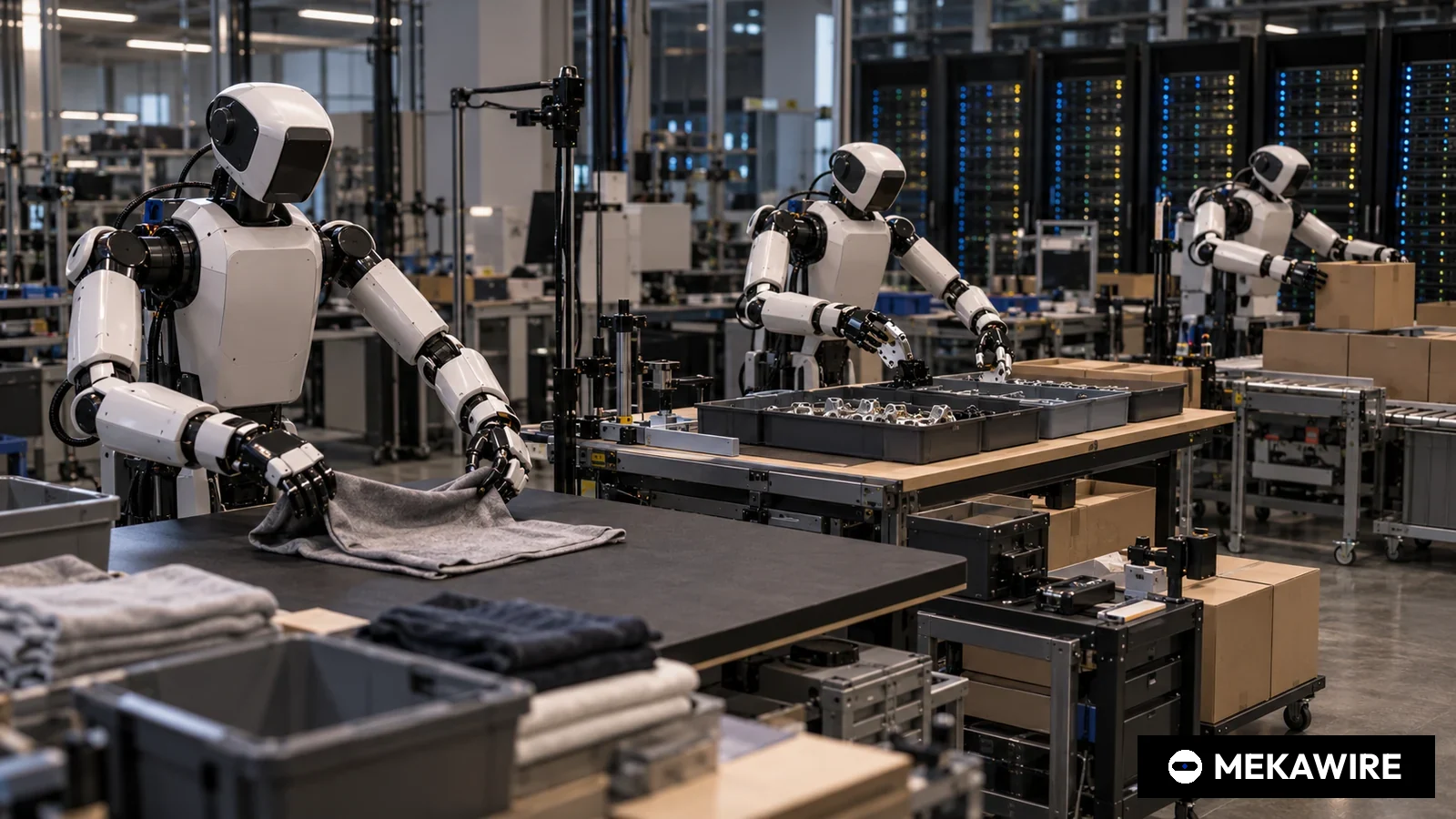
Generalist AI introduced GEN-0 on November 4, 2025, a family of embodied foundation models that the company says improves predictably with more physical interaction data. It reported a capacity threshold at 7 billion parameters, models scaled past 10 billion, and a pretraining corpus of more than 270,000 hours growing by over 10,000 hours a week.
The findings were published as a company blog post, not a peer-reviewed paper.
Generalist AI, a robotics start-up with offices in the San Francisco Bay Area and Boston, introduced GEN-0 on November 4, 2025, describing it as a new class of embodied foundation models trained directly on raw physical interaction. The company's central claim is that robot capability now scales with data and compute in a predictable way, as it has in language models, and that robots below a certain size cannot absorb the data at all.
The numbers in the research post are large by the standards of the field. Generalist said GEN-0 was pretrained on its in-house dataset of more than 270,000 hours of real-world manipulation data gathered in thousands of homes, warehouses and workplaces, and that its operations were adding more than 10,000 hours a week. It reported training runs at 1 billion, 6 billion and 7 billion parameters and said it had since scaled GEN-0 beyond 10 billion parameters.
The headline scientific claim is a phase transition at 7 billion parameters. According to Generalist, 1 billion parameter models showed ossification under data overload, meaning their weights stopped absorbing new information during pretraining, while 6 billion parameter models began to benefit and showed strong multi-task ability. Models of 7 billion parameters and above internalised the pretraining data and transferred it to new tasks with only a few thousand steps of post-training, the company said, adding that it believed this was the first time ossification had been observed in robotics.
The second claim is a scaling law. Generalist said downstream validation error after fine-tuning followed a power law in the size of the pretraining dataset, of the form L(D) = (D_c / D)^α, across 16 task sets that included Lego building, fast food packing and open-ended tasks. In blind A/B tests on real robots, more pretraining data raised task success for models post-trained on only 5.6 hours of task data, equal to 1% of the 550-plus hours available, and the best results, up to 99% in certain cases, came from pairing full pretraining with all task data. The company said the pretraining and post-training sets were collected by different people in different environments.
Generalist also introduced what it calls Harmonic Reasoning, a training method in which the model handles asynchronous, continuous-time streams of sensing and acting tokens so that it can think and act at the same moment. The post presented this as an alternative to the two-system designs used elsewhere, citing Figure AI's Helix as an example, and to inference-time guidance. The company said GEN-0 had run on robots with 6 and 7 degrees of freedom and on semi-humanoid robots with 16 or more, and showed a long-horizon task in which a robot assembles a camera kit in a single stream without explicit subtasks.
The infrastructure disclosures are unusually specific. Generalist said it built custom hardware and dataloaders, laid new dedicated internet lines to collection sites, signed multi-cloud contracts, ran data processing on the order of 10,000 CPU cores and compressed dozens of petabytes, giving it the ability to absorb 6.85 years of manipulation experience per day of training. That is about 60,000 hours a day, which means the whole 270,000-hour corpus passes through training in roughly four and a half days, by MEKAWIRE's calculation. The post did not name its GPU supplier, the model architecture in detail, or its data foundry partners, which it labelled only as Partners A, B and C.
GEN-0 was not released as open weights or a public API in the post, and no technical report or preprint accompanied it. Generalist's earlier public material was a research preview in June 2025. The company's about page says its team previously built the PaLM-E and RT-2 embodied models and came from OpenAI, Boston Dynamics and Google DeepMind.
The comparison with rivals rests on disclosed scale. Physical Intelligence's π0, described in an October 2024 arXiv preprint, has 3.3 billion parameters and was pretrained on more than 10,000 hours of robot data; its π0.5 preprint of April 2025 used about 400 hours of mobile manipulator data from about 100 homes within a wider co-training mix. NVIDIA's GR00T N1, released in March 2025 with open weights, has 2.2 billion parameters and drew on 88 hours of real teleoperation, 827 hours of generated video and simulated data equal to 6,500 hours, its preprint says. Google DeepMind's Gemini Robotics, built on Gemini 2.0 and updated to version 1.5 in September 2025, has not disclosed parameter counts or dataset sizes. On disclosed figures, GEN-0's corpus is up to 27 times π0's.
- GEN-0
- Generalist AI
- 2025-11-04
- 10
- 270,000
- Not announced
- π0
- Physical Intelligence
- 2024-10-31
- 3.3
- 10,000
- No data
- π0.5
- Physical Intelligence
- 2025-04-22
- No data
- 400
- No data
- GR00T N1
- NVIDIA
- 2025-03-18
- 2.2
- 7,415
- Yes
- Gemini Robotics 1.5
- Google DeepMind
- 2025-09-25
- No data
- No data
- No (select partners)
GEN-0 parameters = largest size stated ('10B+'); GEN-0 also reported 1B, 6B and 7B models. π0 = 3.3B including a 300M action expert, pretrained on 'over 10,000 hours' of robot data (arXiv preprint 2410.24164). π0.5 = about 400 hours of mobile manipulator data in about 100 homes, one part of a wider co-training mix (preprint 2504.16054). GR00T N1 = 88 h real teleoperation + 827 h generated video + 780,000 simulated trajectories equal to 6,500 h (preprint 2503.14734); open checkpoint per the paper. Gemini Robotics 1.5: no parameter or data figures disclosed; model limited to select partners. — = not disclosed. Developers' own figures, not independently verified.
As of Oct 1, 2026
The caveats are material. Every result comes from Generalist's own evaluations, the scaling plots are reported without trial counts, and the 99% peak applies to unnamed tasks. The 7 billion parameter threshold was observed on Generalist's data mix and training recipe and may not carry over to other labs. Comparing hours across companies is also imperfect, because Generalist did not break its corpus down by robot data and human-worn device data.
- Pretraining corpus at launch (hours)
- 270,000
- New data per week at launch (hours)
- 10,000
- Training throughput (hours of experience per training day)
- 60,047
- Corpus expressed in training days
- 4.5
- Task-specific post-training data, low-data setting (hours)
- 5.6
- Task-specific post-training data, full setting (hours, '550+')
- 550
- GEN-1 pretraining corpus, April 2, 2026 (hours, 'half a million')
- 500,000
- Implied average weekly growth, Nov 4, 2025 to Apr 2, 2026 (hours)
- 10,805
Disclosed by Generalist AI on Nov 4, 2025 and Apr 2, 2026. Derived: throughput = 6.85 years x 365.25 days x 24 h = 60,047 h per training day; corpus in training days = 270,000 / 60,047 = 4.5; implied weekly growth = (500,000 minus 270,000) / (149 days / 7) = 10,805 h. GEN-1 corpus is described as human wearable data with no robot data, so the growth figure compares corpora that may differ in composition.
As of Oct 1, 2026
Later events show where GEN-0 led. In March 2026 Generalist ran a live GEN-0 demonstration at NVIDIA GTC on a new Universal Robots mobile platform with UR7e arms on a MiR base, which it said it prepared in a few days using no data from the exhibition hall. On April 2, 2026 it released GEN-1, pretrained on half a million hours of physical interaction data with no robot data, which it says lifts average task success to 99% from GEN-0's 64%. On June 4, 2026 it announced $400 million led by Radical Ventures, with NVIDIA among existing investors.
MEKAWIRE analysis
GEN-0 matters less as a model than as the first public claim, with numbers attached, that robot learning has entered a regime where data volume and model size can be planned like a language model budget.
The evidence is internal but coherent. Generalist showed a size threshold, a power law fitted across 16 task sets, real-robot A/B tests, and a data engine whose stated growth rate matches the jump to half a million hours that GEN-1 reported five months later. The implied average of about 10,800 hours a week between the two posts is close to the 10,000-plus hours a week the company claimed in November 2025.
The strongest counter-argument is that none of this has been independently reproduced. The post is a blog, not a preprint, with no released weights, unnamed data partners and no trial counts. Physical Intelligence, NVIDIA and Google DeepMind publish papers or open checkpoints that outsiders can test, and Generalist did not.
Bull case. If the power law holds, Generalist can tell customers how much data a new task needs before collecting it, which turns robot deployment into an engineering budget. Its data lead compounds, and the $400 million raised in June 2026 pays for more collection and larger models.
Bear case. The 7 billion parameter threshold could prove specific to one recipe, while rivals with open models and larger compute budgets close the gap. Hours of data may also matter less than quality, as Generalist's own mixture experiments suggest.
Signals to watch:
- Whether Generalist publishes a preprint or technical report with trial counts for GEN-0 or its successors by the end of 2026.
- Whether outside groups report ossification thresholds in robot models, which would confirm or reject the 7 billion parameter claim during 2027.
- Disclosed paying deployments with named customers in apparel, logistics or electronics, the sectors Generalist listed, through the first half of 2027.
- GEN-0 embodied foundation models
- Blog post; no preprint, open weights or public API announced
- November 4, 2025 (Generalist AI research blog)
- GEN-1, April 2, 2026
- More than 10,000 new hours per week at launch
- More than 270,000 hours of real-world manipulation data
- Phase transition at 7B; 1B models ossify
- 6-DoF, 7-DoF and 16+ DoF semi-humanoid robots
- 6.85 years of manipulation experience per training day
- 1B, 6B, 7B; later scaled beyond 10B parameters
Why it matters
Robot learning has lacked the one tool that made language model investment rational, a reliable curve linking data and compute to performance. GEN-0 is the first commercial claim to supply such a curve for physical manipulation, and the company says it already uses it to estimate how much data a partner's task will need, citing a clothes handling task where it projected performance at 1 billion action trajectories.
If the claim survives scrutiny, it reframes the competition around data operations rather than clever architectures. A lab that can add 10,000 hours of real-world interaction a week, and prove that each hour moves the error curve, has a cost advantage that is hard to copy quickly. That is a different bet from simulation-heavy approaches such as NVIDIA's, where GR00T N1 relied on 6,500 hours' worth of simulated trajectories generated in 11 hours.
Rival analysis
Physical Intelligence is the closest rival in philosophy, a start-up building general models across many robot bodies. Its π0 preprint disclosed 3.3 billion parameters and more than 10,000 hours of robot data, and π0.5 targeted generalisation to unseen homes. Physical Intelligence publishes preprints, which gives it credibility with researchers that a blog post does not. CapitalG led its Series B on November 20, 2025, sixteen days after GEN-0 appeared, without disclosing the amount on its page.
NVIDIA and Google DeepMind compete from platform positions. NVIDIA released GR00T N1 as an open 2.2 billion parameter checkpoint to seed a humanoid ecosystem built on its chips, and is also an investor in Generalist. Google DeepMind keeps Gemini Robotics 1.5 with select partners and offers the reasoning model Gemini Robotics-ER 1.5 through its API. Neither discloses data hours, which makes Generalist's 270,000-hour figure a deliberate positioning move as much as a technical disclosure.
Valuation context
Generalist did not announce funding with GEN-0. Its first disclosed figure came on June 4, 2026, when it raised $400 million led by Radical Ventures, bringing total funding above $500 million, without a valuation. Existing investors named then included NVIDIA, Boldstart Ventures, Spark Capital, Bezos Expeditions and NFDG.
Against peers, that sits below Skild AI's $1.4 billion Series C at $14 billion in January 2026 and Figure AI's $1 billion Series C at $39 billion in September 2025, according to those companies. The scaling-law narrative introduced with GEN-0 is the core of the investment case, because it argues that capital converts into capability on a predictable schedule.
Supply-chain implications
The disclosed supply chain is mostly about data rather than hardware. Generalist describes a global network of thousands of collection devices and robots, multiple data foundry partners working in three operational classes from narrow task collection to do-anything data, dedicated internet lines, custom upload machines and multi-cloud contracts. It did not name its compute provider or its partners.
On the robot side, GEN-0 was tested on 6 and 7 degree-of-freedom arms and 16-plus degree-of-freedom semi-humanoids, and in March 2026 ran on Universal Robots UR7e arms mounted on a MiR mobile base. That suggests a strategy of running on commodity industrial hardware rather than building proprietary robots, which lowers capital needs but leaves the company dependent on arm makers' roadmaps.
Signals to watch
The first signal is publication. A preprint with trial counts, data composition and the fitted scaling coefficients would let outsiders test the 7 billion parameter threshold. Generalist's later posts, including GEN-1 in April 2026 and GEN-1.5 in August 2026, continued in blog form.
The second is commercial evidence. Generalist said its scaling laws cover partner and customer-inspired workflows in apparel, manufacturing, logistics, automotive and electronics. Named customers, fleet sizes or revenue would show whether the curve translates into contracts. The third is whether rivals start disclosing data hours, which would indicate that the industry accepts hours as the relevant metric.
Analyst view
Thesis: GEN-0 is a credible but unverified first draft of scaling laws for robotics, and its main effect was to shift the conversation from model architecture to data throughput. Confidence: medium.
Reasons for medium rather than high: the results are self-reported, the post lacks trial counts and named tasks for the 99% peak, and the corpus composition is not broken out. Reasons for medium rather than low: the claims are internally consistent, the reported data growth matched the half-million-hour corpus Generalist disclosed with GEN-1, and the company's live GTC demonstration on an unfamiliar Universal Robots platform in March 2026 is an outside-visible test of generalisation.
Questions you should be asking
How much of the 270,000-hour corpus came from robots and how much from human-worn devices, given that GEN-1 was later described as pretrained without robot data? What compute budget produced the 10 billion parameter models, and on which hardware?
Does the 7 billion parameter threshold shift with data quality, as Generalist's own mixture experiments hint? And how were the blind A/B evaluations scored, over how many trials, and on which robots?