Formic raises $50M led by Mercato to move its robot-rental fleet toward general-purpose robots
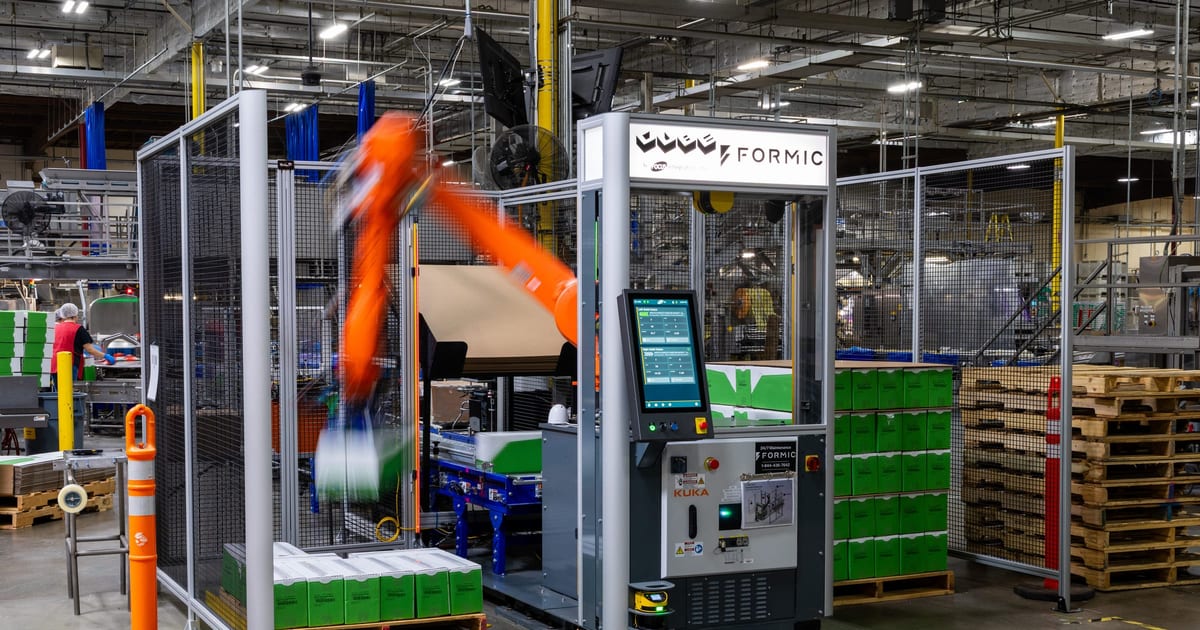
Formic said on Oct 22 that it raised $50 million in growth capital, a Series B led by Mercato Partners with Light Ray Ventures, Lightscape Partners and Citi plus debt from S2G Investments; it did not split equity from debt.
The Chicago robots-as-a-service company reports more than 750,000 hours of live production across 100+ US facilities, 99.6% fleet uptime and 97% renewals, and is working with Physical Intelligence to adapt robot foundation models for factories.
Formic, the Chicago company that rents factory robots to US manufacturers instead of selling them, said on Oct 22 that it has raised $50 million in growth capital. The package combines a Series B led by Mercato Partners, with Light Ray Ventures, Lightscape Partners, Citi and other new and existing investors, and debt financing from S2G Investments. The press release does not say how much of the $50 million is equity and how much is debt, and Formic gave no valuation.
The number that matters more than the round size is the operating record behind it. Formic says its robots have now logged more than 750,000 hours of live production. In its June 2024 funding release the figure was 100,000 hours. That is a 7.5-fold increase in about 28 months, and it is the asset Formic now wants to turn into something bigger than a rental business.
What the money is for: from palletizers to general-purpose robots
Formic's business today is task-specific automation. It installs robots for palletizing, case packing, machine tending, kitting and assist work in food and beverage, consumer goods, chemicals, aerospace, defense and packaging plants, and charges a single recurring monthly payment that covers the equipment, deployment software, field service, maintenance, financing and performance monitoring. The customer puts up no capital. The company says it runs hundreds of robots in more than 100 facilities across over 30 states, with 99.6% fleet uptime and a 97% renewal rate.
The new money is meant to move that platform toward general-purpose robotics, the company said, so that more types of robots can take on more complex jobs through the same service model. It will also fund an expansion into metal fabrication and deeper work in aerospace, space, defense, medical and energy. Formic assembles and tests robots at a new facility in Bolingbrook, Illinois, and develops new capabilities at an R&D centre in Oakland, California. It says it now puts robots into production about three times faster than a year ago.
Why Physical Intelligence is the detail to watch
The most strategic line in the release is a partnership. Formic says it is working with Physical Intelligence to combine that company's robot foundation models with Formic's production data and operating know-how, adapting the models for manufacturing tasks. Physical Intelligence, which raised a $600 million Series B in November 2025, highlighted Formic in its Pi API beta announcement, according to Formic. A foundation model of this kind is a single neural network trained on many robots and tasks that can be fine-tuned to a new job with far less programming than a classic robot cell. MEKAWIRE's explainer on VLA models covers how they work.
The division of labour is the point. Model companies have the software but no factory footprint; Formic has the footprint, the service crews and the financing, and every installed robot generates data on tasks, conditions and corrections. Mercato managing director Ryan Sanders, who joins Formic's board, framed the bottleneck as the loading dock rather than the lab.
How the round compares
- 2022-01-18
- Series A
- 26.5M
- Lux Capital
- 2024-06-25
- Series A extension
- 27.4M
- Blackhorn Ventures
- 2026-10-22
- Series B and debt
- 50M (incl. undisclosed debt)
- Mercato Partners; debt from S2G Investments
Company press releases. Total disclosed: $103.9M including debt in the latest round. Gap between rounds: 29 months, then 28 months.
As of Oct 23, 2026
Formic has raised $103.9 million in disclosed capital since January 2022, with its rounds spaced 29 and 28 months apart. Method: sum of the three announced amounts; the latest includes an undisclosed share of debt.
- 2026-03-11
- Mind Robotics
- Series A
- 500M
- 2026-05-13
- Mind Robotics
- Series A-1
- 400M
- 2026-06-09
- Standard Bots
- Series C
- 200M
- 2026-02-04
- Machina Labs
- Series C
- 124M
- 2026-01-27
- Vention
- Venture round
- 110M
- 2026-01-29
- RobCo
- Series C
- 100M
- 2026-10-06
- Multiply Labs
- Series B
- 75M
- 2026-10-22
- Formic
- Series B and debt
- 50M
Verified MEKAWIRE rows, companies with primary category industrial robots, Oct 23, 2025 to Oct 22, 2026. Disclosed amounts, not estimates.
As of Oct 23, 2026
Against the industrial-robot companies in MEKAWIRE's database, the round is small. Standard Bots raised a $200 million Series C in June and RobCo, which also offers robots on a subscription, raised $100 million in January. Mind Robotics took $900 million across two Series A tranches this year. Formic's $50 million is the smallest of the eight rounds of $50 million or more in the category over the past 12 months.
MEKAWIRE analysis
Formic is raising money for the delivery layer of physical AI, not for a robot: its bet is that general-purpose models will reach factories through whoever already owns the installed fleet, the service crews and the financing.
The evidence is in Formic's own numbers. A 97% renewal rate held between the 2024 and 2026 releases while production hours grew 7.5 times, which suggests the service model scales without customers churning. The Physical Intelligence tie gives Formic a route to more capable robots without building its own model.
The counter-argument is capital. Robots-as-a-service puts equipment on Formic's balance sheet, which is why the round includes debt and why the 2022 round came with access to more than $100 million of equipment financing. A modest equity raise, an undisclosed debt share and no valuation make it hard to judge how much growth capital Formic actually gained. Model companies could also sell directly to integrators and robot makers, leaving rental fleets as one channel among many.
Bull case: general-purpose models cut deployment time again, Formic's fleet becomes a data source model partners pay for, and the next round prices it as a platform. Bear case: hardware and service costs grow with the fleet, rivals with $100 million-plus rounds expand into rental, and the foundation-model work stays a pilot.
Signals to watch: a first named factory deployment using Physical Intelligence models; any Form D or release that splits equity from debt; and whether Formic's next update moves the 100-facility and 30-state counts.
- S2G Investments
- General-purpose robotics, metal fabrication; work with Physical Intelligence on robot foundation models
- Ryan Sanders, Managing Director at Mercato Partners, joins
- Hundreds of robots in 100+ facilities across 30+ US states
- Robots-as-a-service: equipment, software, maintenance and financing for one recurring monthly payment
- $50M growth capital (Oct 22, 2026), equity and debt split not disclosed
- Series B led by Mercato Partners; Light Ray Ventures, Lightscape Partners, Citi and others joined
- 750,000+ hours of live production, 99.6% uptime, 97% renewal rate
Why it matters
Formic is one of the few US robot companies whose disclosures describe a running commercial fleet rather than pilots: hundreds of robots, 100+ plants, 750,000+ production hours, 99.6% uptime, 97% renewals. That record is what model developers lack. If foundation models are to reach mid-sized US factories, someone has to finance, install and service the hardware, and Formic is positioning itself as that layer.
Rival analysis
Standard Bots ($200M Series C, June 2026) and RobCo ($100M Series C, January 2026) sell their own robots, with RobCo also offering subscriptions in Europe. Vention ($110M) sells a self-serve design and deployment platform. Formic is hardware-agnostic and integrates arms from Universal Robots, FANUC, KUKA and ABB, so its competition is as much traditional system integrators as robot startups. Mind Robotics ($900M across two tranches) sits in a different weight class.
Valuation context
No valuation was disclosed. The only figure on record is Formic's January 2022 statement that it was valued at more than $100 million. The $50 million mixes equity and debt in an undisclosed split, so neither a step-up nor a dilution estimate can be derived. Formic's disclosed total of $103.9 million includes that debt.
Supply-chain implications
Formic builds cells around arms from established makers (Universal Robots, FANUC, KUKA, ABB per its earlier disclosures), assembles and tests them in Bolingbrook, Illinois, and runs R&D in Oakland. Its exposure is to arm pricing and lead times, grippers, vision and conveyors, plus the cost of field-service labour across 30+ states. A move into metal fabrication adds welding and cutting equipment.
Signals to watch
A first public deployment that uses Physical Intelligence models in a Formic cell; a Form D or financing disclosure separating equity from S2G debt; updated fleet counts beyond 100 facilities; first metal-fabrication customers; further board or executive hires from Mercato's network.
Analyst view
Thesis: Formic is betting that physical-AI value accrues to whoever owns deployment, service and financing. Confidence: medium. The operating metrics are strong and consistent across two releases, but the round is small for the category and the debt share is unknown, which limits how far the company can expand an asset-heavy fleet.
Questions you should be asking
How much of the $50 million is equity and how much is S2G debt? What share of revenue comes from the top ten customers? Which Formic sites run Physical Intelligence models today and with what task success? How does gross margin on a robot change between year one and year three of a contract? Will Formic finance robots from humanoid makers?