Hugging Face buys Bordeaux humanoid maker Pollen Robotics and starts selling its $70,000 open-source Reachy 2
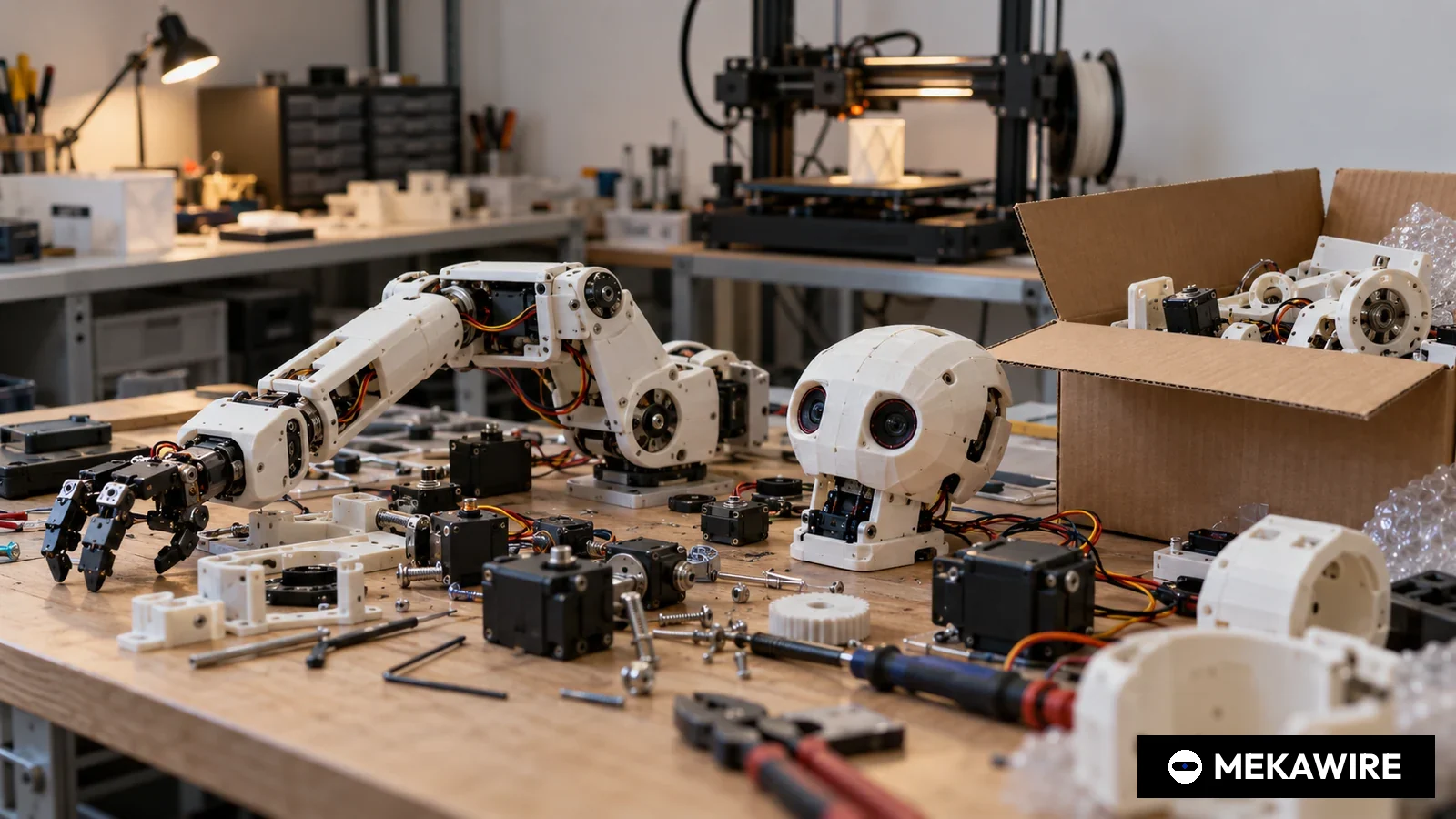
Hugging Face said on 14 April 2025 that it had acquired Pollen Robotics, the French maker of the Reachy humanoid robots, its fifth acquisition. It will sell Pollen's Reachy 2 at US$70,000 as its first robot and tie the hardware to its open-source LeRobot software; the price and terms of the deal were not disclosed.
Hugging Face said on 14 April 2025 that it had acquired Pollen Robotics, the Bordeaux company that builds the Reachy humanoid robots, and that Pollen's Reachy 2 would be the first robot it offers for sale. The announcement on Hugging Face's blog, signed by Thomas Wolf and Clem Delangue together with Pollen co-founder Matthieu Lapeyre and the Pollen team, did not give a purchase price or any other financial terms.
Hugging Face called the deal its fifth acquisition, following Gradio and XetHub. Reachy 2 is listed at US$70,000, and the post said buyers could already order one by contacting Pollen's sales team. Neither company disclosed the price paid, how it was settled, or how many Pollen employees moved across. Pollen's own About page shows its last disclosed financing was a €2.4 million seed agreement in April 2023, and the site now describes the company as part of Hugging Face.
The robot on offer is a research platform rather than a factory worker. Hugging Face describes Reachy 2 as a lab partner for the AI era that is already in use at Cornell University and Carnegie Mellon University. Each of its two arms has seven degrees of freedom and can lift up to 3 kg, according to Pollen's product page, and its movement relies on Pollen's Orbita joint system, which lets a joint turn in several directions at once. Reachy 2 rides on a mobile base with three omniwheels and a LiDAR sensor, runs on ROS 2 Humble, and can be programmed through a Python SDK or teleoperated with a virtual reality headset. Pollen says the software is fully open source.
Hugging Face presented the purchase as a statement of how it wants robotics to develop. Wolf wrote that robotics could be the next frontier unlocked by AI and that it should be open, affordable and private, so that hobbyists and enterprises alike can build robot assistants starting from open solutions instead of closed, remotely controlled hardware. Lapeyre wrote that Pollen had been built with open source at its core and called Hugging Face a natural home for a shared goal of putting AI and robotics in everyone's hands. The post placed the deal at the end of a year of work on LeRobot, Hugging Face's open robotics library, but set no timetable for new robots or for specific integration steps.
That LeRobot record is the context for the deal. Hugging Face's robotics team announced the library in May 2024, and the post says it has passed 12,000 stars on GitHub with more than 100 repositories on the Hugging Face Hub. In October 2024 LeRobot and The Robot Studio released the SO-100 arm, which Hugging Face put at about US$100. In November 2024 NVIDIA announced a collaboration to speed up LeRobot's data collection, training and verification workflow, and in March 2025 NVIDIA released its GR00T N1 humanoid foundation model on Hugging Face. Until April 2025, Hugging Face had software, cheap arms and partners, but no robot of its own to sell.
Pollen was founded in 2016 by Lapeyre and Pierre Rouanet, former researchers in the Flowers developmental robotics team at Inria, the French national computer science institute. Its first Reachy was launched at CES 2020, and VR teleoperation followed in 2021. In 2022 Pollen took second place in the ANA Avatar XPRIZE, a prize the company says was worth US$2 million. Hugging Face's post credits Pollen with hundreds of units deployed in more than 20 countries, while Pollen's About page puts the figure at around 100 Reachy robots in about 20 countries. Users named by Hugging Face include Accenture, the French research bodies CEA and CNRS, Cornell and Carnegie Mellon.
The purchase put Hugging Face among Europe's humanoid hardware players, but at a different scale from the venture-backed groups. Pollen's disclosed seed round was €2.4 million. Wandercraft, a French exoskeleton maker founded in 2012, announced a US$75 million Series D in June 2025. London's Humanoid raised US$152 million at a US$1.35 billion post-money valuation in July 2026, and Italy's Generative Bionics announced a US$81 million seed round in December 2025. Germany's NEURA Robotics announced a Series C in June 2026. In the United States, Figure AI raised a US$675 million Series B in February 2024 and keeps its software closed, which is the model Wolf's post argues against.
- Pollen Robotics
- FR
- 2016
- Seed (before acquisition)
- 2023-04
- 2.4
- EUR
- No data
- Wandercraft
- FR
- 2012
- Series D
- 2025-06-11
- 75
- USD
- No data
- Humanoid
- GB
- No data
- Series A
- 2026-07-21
- 152
- USD
- 1350
- Generative Bionics
- IT
- No data
- Seed
- 2025-12-09
- 81
- USD
- No data
- NEURA Robotics
- DE
- 2019
- Series C
- 2026-06-10
- No data
- No data
- No data
- 1X Technologies
- US
- 2014
- Series B
- 2024-01-13
- 100
- USD
- No data
Pollen figure from its own About page; the price Hugging Face paid in April 2025 was not disclosed, so no acquisition value is shown. Peer figures from company announcements in the MEKAWIRE verified database; Wandercraft's release describes the Series D as bringing US$75 million in total funding, and NEURA's Series C amount is left blank because it was not verified here. Rounds dated after April 2025 are shown as of 1 October 2026. Figures disclosed, not estimated.
As of Oct 1, 2026
The technical bet is about data. Teleoperation lets a person wearing a VR headset move the robot's arms directly, and each session produces a recorded demonstration of a task. Those demonstrations are the raw material for imitation learning, where a neural network learns to copy the human operator. LeRobot was built to share such datasets and trained models on the Hugging Face Hub, and an open, VR-ready robot that labs already own gives that library a reference machine whose recordings others can reuse.
For the wider industry, the deal moved a platform best known for hosting AI models into selling physical products. That brings inventory, servicing and spare parts into a business that had run on software and cloud usage, and it makes Hugging Face a direct supplier to the university and corporate labs that also use its Hub.
Several questions were left open. Hugging Face did not say how many Reachy 2 units it expected to sell or whether the US$70,000 price would change, and the gap between that price and the roughly US$100 SO-100 arm shows how far apart its two hardware lines sit. The two companies' own deployment figures differ. With no disclosed price, the deal cannot be valued against Pollen's 2023 seed round, and staff retention in Bordeaux was not addressed.
Later disclosures added detail. On 9 July 2025 Hugging Face and Pollen introduced Reachy Mini, a small open-source desktop robot; the Hugging Face post now lists it at US$399 for the Lite version and US$499 for the wireless one, with hardware, software and simulation published openly. Pollen's site today lists Reachy Mini, Reachy 2 and a small robot called Microduck. The next markers are new Reachy 2 users named by Hugging Face or Pollen, Reachy 2 support in LeRobot releases, and whether Pollen returns to CES, where Reachy first appeared in 2020.
MEKAWIRE analysis
Hugging Face bought a small open hardware team so that LeRobot would have a reference robot of its own, and the purchase will be judged by how much shared training data flows from Reachy machines, not by unit sales.
The evidence sits in the announcement itself. Hugging Face disclosed no price and no sales target, but it published a detailed LeRobot timeline, a US$70,000 price list and a manifesto for open, affordable and private robots. A company optimising for hardware revenue would not lead with a research robot whose named users are university and corporate labs. A company building a data and model ecosystem would want exactly that installed base.
The strongest counter-argument is that hardware dilutes a software business. Robots need assembly, logistics and field service, and a US$70,000 machine competes for the same lab budgets as lower-cost Chinese platforms such as Unitree's. Hugging Face could have kept supporting third-party robots in LeRobot without carrying any of that cost.
Bull case. Reachy becomes the default open research humanoid, datasets recorded on it fill the Hugging Face Hub, and the cheaper Reachy Mini line brings in hobbyists who then move to LeRobot models. Hugging Face ends up as the neutral home for robot data in the way it became the home for open model weights.
Bear case. Hardware support absorbs management attention, Reachy 2 stays a niche lab product, and Chinese makers ship lower-cost platforms that LeRobot supports anyway. The acquisition then looks like an expensive way to buy a brand and a team in Bordeaux.
Signals to watch.
- By 31 December 2026: whether Hugging Face or Pollen names new Reachy 2 customers beyond the labs listed in April 2025.
- January 2027: whether Pollen shows new Reachy hardware at CES 2027, the show where Reachy launched in 2020.
- First half of 2027: the next LeRobot release after version 0.6, and whether it ships policies or datasets recorded on Reachy robots.
- Pollen Robotics, Bordeaux, founded 2016
- Launched May 2024; over 12,000 GitHub stars at announcement
- Hugging Face (fifth acquisition, after Gradio and XetHub)
- Matthieu Lapeyre and Pierre Rouanet, formerly of Inria's Flowers team
- Open source, ROS 2 Humble, Python SDK, VR teleoperation
- 14 April 2025, Hugging Face blog
- Two arms, 7 degrees of freedom each, up to 3 kg per arm
- Not disclosed
- Reachy 2 at US$70,000
- €2.4 million seed, April 2023
Why it matters
Hugging Face is best known for hosting open AI models, and this was the first time it bought a company that makes physical products. The announcement turns LeRobot from a library that supports other people's robots into a stack with a house robot, a price list and a sales channel.
The absence of disclosed terms is telling in its own way. Hugging Face chose to publish a product price, a list of lab customers and a LeRobot timeline rather than any deal value, which signals that it wanted the acquisition read as a product and ecosystem move rather than a financial one.
Rival analysis
Most well-funded humanoid companies keep their software and models proprietary. Figure AI raised US$675 million in February 2024 and develops its own models; 1X, NEURA Robotics and Humanoid have each raised far more than Pollen's €2.4 million seed. Pollen's advantage is not scale but openness and an installed base in research labs such as Cornell, Carnegie Mellon, CEA and CNRS.
The more direct competition for lab budgets comes from lower-cost platforms, including Unitree's robots, which LeRobot users can also adopt. Reachy 2 at US$70,000 competes on openness, VR teleoperation and support rather than on price.
Valuation context
No price was disclosed, so no valuation can be derived. The only verified financing figure for Pollen is the €2.4 million seed agreement of April 2023, plus the US$2 million XPRIZE award it reports for 2022.
Peer rounds show how far Pollen sat from the capital-intensive end of the humanoid market. Humanoid's US$1.35 billion post-money valuation in July 2026 and Wandercraft's US$75 million Series D are on a different scale, which suggests Hugging Face bought a team and a product line rather than a scaled manufacturer. That is an inference, not a disclosed fact.
Supply-chain implications
Reachy 2 is a low-volume product built around Pollen's own Orbita joint mechanism, seven-degree-of-freedom arms, an omniwheel base with LiDAR and a CPU-based compute system. Pollen has not published supplier names, production volumes or where final assembly takes place.
The SO-100 arm, released with The Robot Studio at about US$100, follows a different model built on off-the-shelf parts and self-assembly. Hugging Face now spans both ends of that range, which will test whether one company can support kit-level and premium research hardware at the same time.
Signals to watch
The first signal is customer disclosure: whether Hugging Face or Pollen names new Reachy 2 buyers beyond the institutions listed in April 2025. The second is software: whether LeRobot releases ship official Reachy 2 support, datasets or trained policies.
The third is product cadence. Reachy Mini, introduced on 9 July 2025, showed Pollen moving down market under Hugging Face; a new or cheaper full-size humanoid would show whether the open, affordable goal reaches the Reachy 2 class.
Analyst view
Thesis: the acquisition is a data and ecosystem investment dressed as a hardware launch, and it should be judged by how much robot data and how many models built on Reachy machines appear on the Hugging Face Hub.
Confidence: medium. The stated rationale, the LeRobot timeline and the later Reachy Mini launch support the thesis. Confidence is not high because no deal value, revenue, unit sales or integration roadmap has been disclosed, and the two companies' own deployment counts differ.
Questions you should be asking
What did Hugging Face pay, and was it settled in cash, shares or both? How many Pollen employees remain in Bordeaux, and will hardware development stay in France?
How many Reachy 2 units has Pollen sold since April 2025, and at what price? Will Reachy 2 hardware designs be published with the same openness as Reachy Mini's?