Sereact's dual-arm robots go live on Zalando fashion returns at CEVA warehouses in Germany and Poland, 79 days after Zalando invested
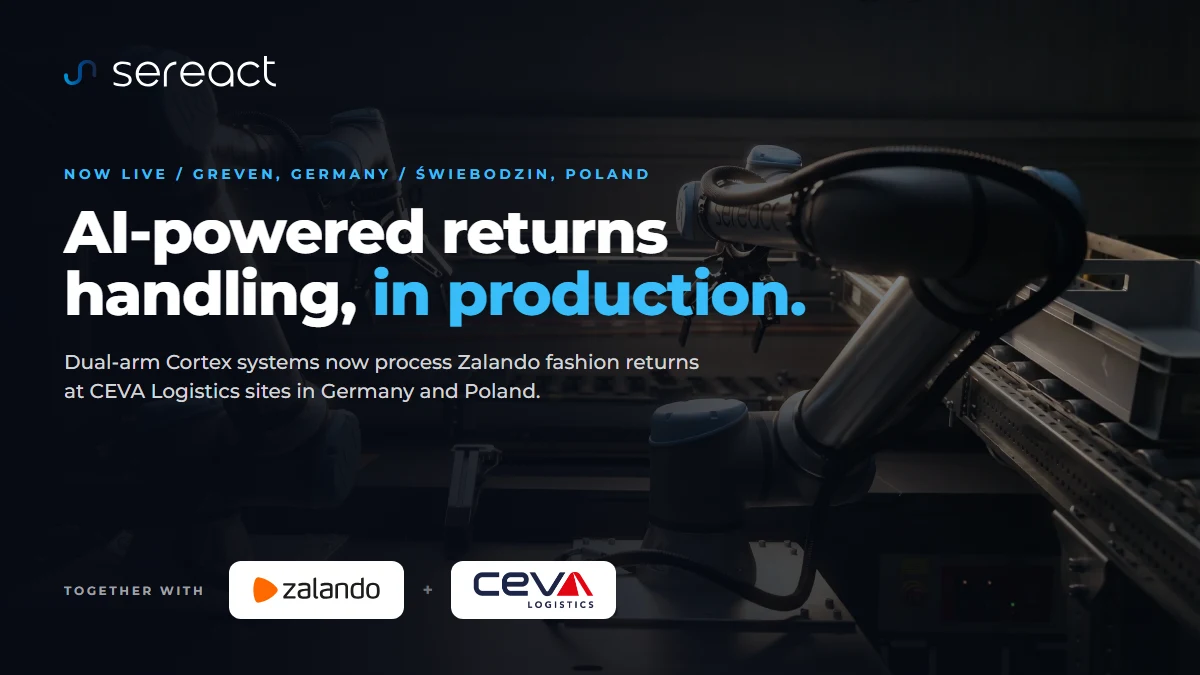
Sereact, Zalando and CEVA Logistics said on Oct 7, 2026 that dual-arm robots running Sereact's Cortex model are now in live operation sorting returned Zalando fashion items at CEVA sites in Greven, Germany, and Świebodzin, Poland, sold to CEVA as robotics-as-a-service.
It is the first operational milestone of the partnership that began when Zalando joined Sereact's Series B on July 20, lifting the round to US$116 million.
Seventy-nine days after Zalando bought into Sereact, the Stuttgart company's robots are sorting Zalando's returns. Sereact, Zalando and CEVA Logistics said on Oct 7, 2026 that dual-arm robots running Sereact's Cortex model had entered live operation at CEVA fulfilment sites in Greven, Germany, and Świebodzin, Poland, where they grasp, identify and sort returned fashion items. The companies called it the initial phase of a plan to scale returns automation across Europe.
Returns are the job warehouse robotics has avoided longest, and that is the point of the announcement. Whether a model that has never seen a crumpled jacket in a torn bag can handle one at Zalando volumes is the question this deployment is meant to answer, and the companies have so far published the claim but not the numbers.
What went live, and who pays for it
The robots work without per-item training or fixed SKU profiles, the companies said, meaning the system does not need to be taught each article before it can pick it. CEVA operates them for Zalando under a robotics-as-a-service (RaaS) contract, so the logistics provider rents capacity rather than buying hardware. Staff at the sites move to station supervision, exception handling and quality control, according to the release.
The partners did not disclose how many robots are installed, how many items they process per hour, their error rate or the value of the contract. Chris Walton, CEVA's senior vice president for contract logistics, said in the release that returns combine unpredictable volumes, manual quality checks, seasonality, value decay and a disproportionately high cost per unit, and that the RaaS model classifies items faster with fewer manual touchpoints. Masood Choudhry, Zalando's senior vice president for logistics, described the work as solving the most complex challenges in fulfilment.
Why returns are the hardest pick
A returned garment arrives folded badly or not at all, often in a re-used bag, with tags in different places. A classic picking robot relies on known item geometry or a barcode facing up. Sereact chief executive Ralf Gulde said in the release that a system working only on articles it has seen before does not work in a returns operation at all, and called production at Zalando volumes the strongest proof point the company has.
That is where Cortex comes in. In April Sereact described its next version, Cortex 2.0, as a vision-language-action model paired with a world model that scores candidate motions for stability, risk and efficiency before the arm moves, and said its fleet had completed more than 1 billion production picks with one remote intervention in about 53,000. The returns stations are the dual-arm form factor Sereact listed alongside single-arm picking cells and humanoids.
The money behind the milestone
Zalando joined Sereact's Series B as a strategic investor on July 20, lifting the round led by Headline from US$110 million to US$116 million and Sereact's total raised to more than US$145 million. The July release said the partners were already working to scale automation across their shared European logistics footprint. The October go-live is the first public result of that pairing, 163 days after the original Series B.
The customer list moved too. Sereact's October release names Zalando, IKEA, DHL, Rohlik, Arvato, alza.cz, BMW, Mercedes-Benz and Daimler Truck. Five of those nine, Zalando, IKEA, DHL, Arvato and alza.cz, were not in the eleven names it listed with the Series B in April. Boilerplate lists are selective, so this shows which names the company now chooses to lead with, not when contracts were signed.
Where it sits against rivals
In MEKAWIRE's database the closest European rival is Poland's Nomagic, whose latest disclosed round was a US$44 million Series B in February 2025; Sereact's round is 2.6 times larger. In the US, Covariant, Nimble Robotics, Pickle Robot and Plus One Robotics have raised comparable or smaller rounds. None of them appears in MEKAWIRE's records with a live returns deployment for a fashion platform.
MEKAWIRE analysis
The deal matters less as a robot sale than as a distribution model: by putting its model inside a third-party logistics provider's RaaS offer, Sereact gets Zalando-scale data without carrying the hardware on its own balance sheet.
- Sereact
- DE
- Series B (incl. Zalando)
- 116
- 2026-04-27
- Pickle Robot
- US
- Series B
- 50
- 2024-11-20
- Nimble Robotics
- US
- Series C
- 106
- 2024-10-23
- Nomagic
- PL
- Series B
- 44
- 2025-02-26
- Covariant
- US
- Series C extension
- 75
- 2023-04-04
- Plus One Robotics
- US
- Series C
- 50
- 2023-03-06
Verified company and investor announcements in the MEKAWIRE database, as of Oct 17, 2026. Figures are disclosed, not estimated. Sereact's round is 2.6 times Nomagic's (116 / 44), the other European picking specialist in the table.
As of Oct 17, 2026
The evidence is in how the deal is structured. Zalando is investor and end customer, CEVA operates and pays for capacity, and Sereact supplies the model. CEVA's scale, US$18.3 billion of 2025 revenue and more than 1,700 facilities by its own count, is the route by which one site becomes many without Sereact selling to each warehouse owner. Every returned item the robots handle also feeds the data loop Sereact describes as its moat.
- 2026-04-27
- Series B
- US$110m led by Headline; 200+ systems live in Europe, 1bn+ production picks, first US office in Boston
- 2026-06-01
- Veloq partnership
- Global partnership for e-grocery fulfilment
- 2026-07-15
- Cortex 2.5
- Learns short tasks from two or three video demonstrations at run time
- 2026-07-20
- Zalando joins Series B
- Round grows to US$116m; total raised over US$145m
- 2026-10-07
- Zalando returns live with CEVA
- Dual-arm Cortex systems at Greven (DE) and Świebodzin (PL)
Sereact posts. Derived: Series B to go-live = 163 days (Apr 27 to Oct 7); Zalando investment to go-live = 79 days (Jul 20 to Oct 7).
As of Oct 17, 2026
The strongest counter-argument is that nothing measurable has been published. Without robot counts, throughput or accuracy, the deployment could be a handful of stations in a pilot hall. Returns also carry a quality-control step that the release says humans still own, so the share of the process automated is unknown.
Bull case: further CEVA sites serving Zalando go live in 2027, CEVA offers the same RaaS stations to other fashion clients, and Sereact publishes returns throughput that supports a larger round. Bear case: the rollout stalls at two sites, returns prove too variable for unit economics, and integrators bundle cheaper picking AI.
Signals to watch: a named third CEVA or Zalando site; any throughput or accuracy figure for the returns stations; and Sereact's appearance at LogiMAT in Stuttgart in March 2027, where a returns line would be the natural showcase.
- Sereact, Zalando and CEVA Logistics said on Oct 7, 2026 that AI-driven automated returns processing is live at CEVA fulfilment sites in Greven, Germany, and Świebodzin, Poland.
- The systems are dual-arm robots running Sereact's Cortex physical AI model; they grasp, identify and sort returned fashion items without per-item training or fixed SKU profiles, the companies said.
- CEVA operates the robots for Zalando returns under a robotics-as-a-service model; the companies call the deployment the initial phase of a broader plan to scale returns automation across Europe.
- Zalando joined Sereact's Series B as a strategic investor on July 20, 2026, taking the round from US$110 million to US$116 million; the go-live came 79 days later.
- None of the three companies disclosed the number of robots, throughput, accuracy or contract value.
- CEVA, part of the CMA CGM Group, reported 2025 revenue of US$18.3 billion and about 110,000 employees at more than 1,700 facilities; Zalando serves 62 million active customers in 29 markets.
- Sereact's October customer list names nine companies; five of them (Zalando, IKEA, DHL, Arvato and alza.cz) were not in the list it published with its Series B in April.
Why it matters
Returns handling is a large, manual and costly part of fashion e-commerce logistics, and it has resisted automation because items arrive in unpredictable states. A live deployment at a logistics provider of CEVA's size, for Europe's largest fashion platform, is the first public test of whether a general picking model can do this work in production.
For the robot-AI category it is also a test of business model. RaaS through a 3PL lets a software company scale without owning fleets or selling to each warehouse.
Rival analysis
Nomagic in Poland is the most direct European rival in AI picking, with a US$44 million Series B in February 2025 in our data. US rivals Covariant, Nimble, Pickle Robot and Plus One Robotics focus on e-commerce picking, truck unloading and parcel handling.
Sereact's differentiator in this deal is distribution through CEVA plus a strategic investor as end customer. Rivals with similar models would need a comparable 3PL partner to match the route to scale.
Valuation context
Sereact has not disclosed a valuation. Its Series B of US$116 million is the largest disclosed round among AI picking specialists in our database since 2024, and 2.6 times Nomagic's latest.
A RaaS contract with a top-tier 3PL is recurring revenue in principle, but without volumes or prices it cannot be valued. The next round's pricing will depend on whether Sereact discloses revenue tied to deployments like this one.
Supply-chain implications
The dual-arm stations combine third-party robot arms, grippers and 3D vision with Sereact's model; Sereact says its software runs across hardware forms rather than on its own robots. That keeps it exposed to arm and camera suppliers' lead times but free of hardware inventory.
Under RaaS, CEVA or a financing partner carries the asset. Expansion speed therefore depends on CEVA's capital allocation as much as on Sereact's software.
Signals to watch
1. A named third site for Zalando returns with CEVA, which would confirm the scale-up plan. 2. Any published returns throughput, accuracy or intervention rate. 3. LogiMAT 2027 in Stuttgart in March, the natural venue for a returns showcase. 4. Sereact's next funding round and whether it discloses revenue. 5. CEVA offering the same RaaS stations to other fashion customers.
Analyst view
Thesis: the deployment is a distribution win more than a technology demonstration. Confidence: medium. The structure (investor-customer plus 3PL operator) is disclosed; the operating results are not.
What would change our view: published metrics showing returns throughput comparable to manual stations would raise confidence that the model generalises; no new sites by mid-2027 would suggest a pilot rather than a rollout.
Questions you should be asking
1. How many dual-arm stations are live at Greven and Świebodzin, and what share of returns do they process? 2. What is the throughput per station and the intervention rate on returns compared with standard picking? 3. Who owns the hardware under the RaaS contract, CEVA or Sereact or a financier? 4. Which step of returns, including quality grading, remains manual? 5. Which CEVA sites are next, and on what timeline?