What is AutoStore? Cube storage robots with a 72% gross margin and a $700M 2026 goal
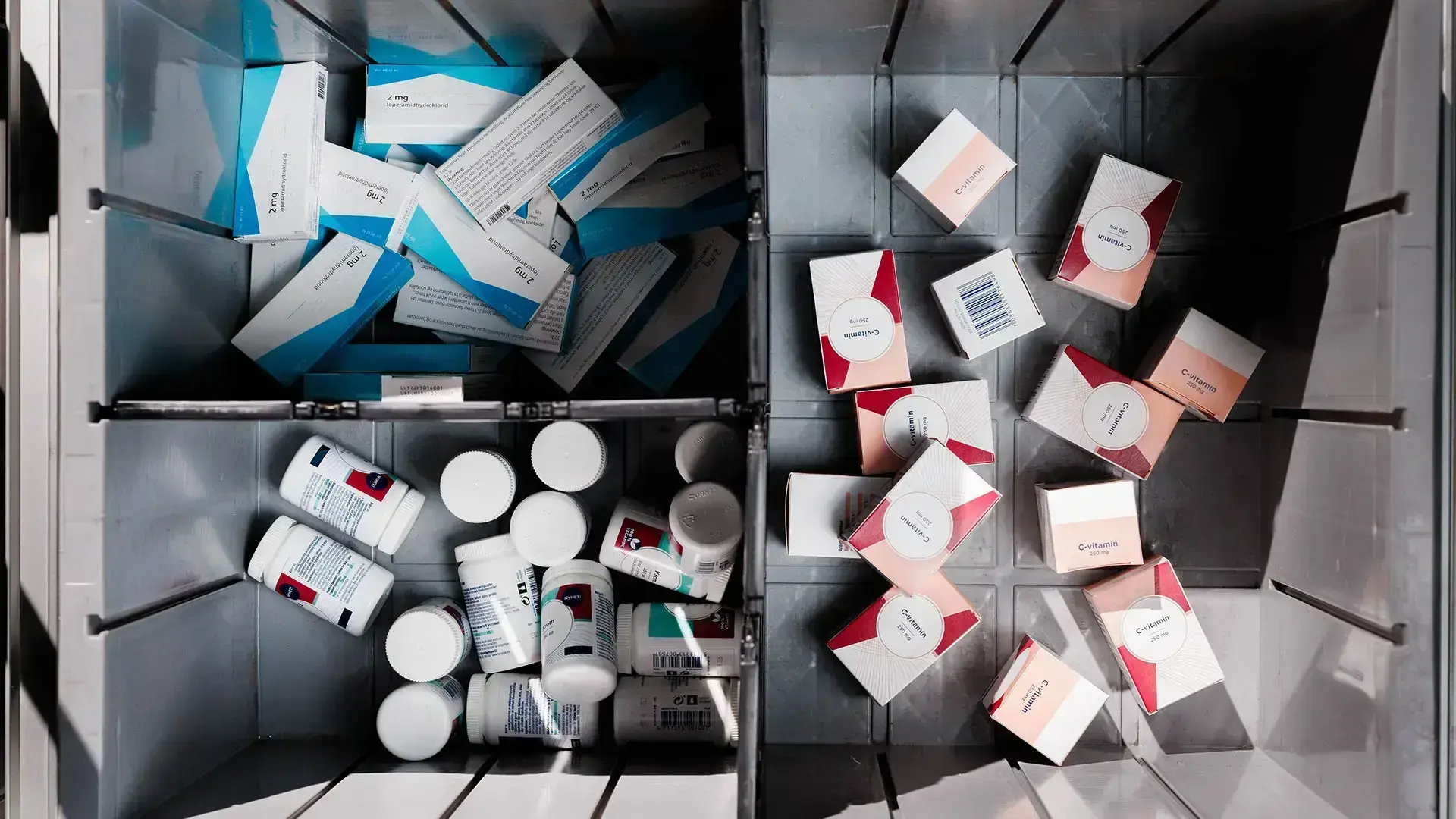
AutoStore is an Oslo-listed Norwegian maker of cube storage: bins stacked in an aisle-free grid, with robots on top that dig out bins and deliver them to picking ports. It counted about 2,000 systems and 92,500 robots in 68 countries in Q2 2026, sells through integrators at a 72.2% gross margin, and guides 2026 revenue to about $700 million, which implies a second half 4.4% below the first.
AutoStore is a Norwegian company, listed in Oslo under the ticker AUTO, that makes cube storage for warehouses: plastic bins are stacked directly on top of each other inside an aluminium grid with no aisles, and battery robots running on rails across the top dig out the bin an order needs and drop it at a picking port. As of the second quarter of 2026 the company counted about 2,000 systems and about 92,500 robots in 68 countries, serving about 1,350 customers, and it expects revenue of around $700 million this year. See the AutoStore company profile for the data we track.
The searches that bring readers here ask what the robots do and how big the company is. The more useful question is why a hardware maker reports a 72% gross margin when the best-known US rival reports 22%, and whether that gap survives the shift to subscriptions and small sites. This explainer answers both, from AutoStore's own filings.
Latest from MEKAWIRE
- Teradyne Robotics and Sereact sign partnership after hundreds of UR arms shipped in Europe
- Geek+ installs PopPick at MISUMI's new west Japan hub, 149 robots across two sites
- AWS opens its Physical AI Toolchain: NVIDIA Isaac, GR00T and Cosmos as Terraform modules
- What is Teradyne Robotics? UR and MiR near break-even on $100m in Q2 2026
- Geekplus pays RMB50m for 20% of its own founder's eight-month-old robot-brain start-up
The robots only lift bins, which is why the grid packs so much in
An AutoStore system has three parts. The grid is a frame of aluminium columns in which bins sit in stacks. The robots are wheeled units that drive on top of the grid, lower a gripper into a column and lift the requested bin, moving any bins above it to other stacks first. The ports are workstations at the edge where a person or a robot arm takes the item out. Because no aisle is left for people or forklifts, the same floor holds far more goods than shelving does.
Dividing the installed base gives about 46 robots per system on average (92,500 robots divided by about 2,000 systems, MEKAWIRE calculation). Sites range widely. A UK partner runs more than 700 AutoStore robots in its own warehouses, while the small-business line, Pio, is sold as a subscription. A Norwegian online fashion retailer ordered an 80,000-bin Pio grid in October, which AutoStore said is four times larger than any Pio site running today.
Integrators carry the projects, AutoStore keeps the margin
AutoStore does not build whole warehouses. It sells the grid, robots, ports and software through a network of system integrator partners, who design and install the site. It assembles products in Poland and Thailand, according to its Q4 2025 report. That model explains the margin table below. Symbotic, by contrast, engineers and commissions complete systems, mostly for Walmart, and books the labour and steel that come with them.
- AutoStore (Norway)
- Grid, robots and ports sold through integrators
- Q2 2026
- USD 192.1m, +43.4%
- Gross 72.2%, adj. EBITDA 44.9%
- Symbotic (US)
- Builds complete case-handling systems, Walmart-led
- Quarter to June 27, 2026
- USD 720.8m, +22%
- Gross 22.3%
- Geek+ (China)
- Goods-to-person AMRs and shelving systems
- FY2025
- RMB 3,171.0m, +31.6%
- Gross 35.5%
- Ocado Technology Solutions (UK)
- Grid-based grocery fulfilment for licensed retailers
- FY2025 (to Nov 30)
- GBP 561.2m, +13.0%
- Adj. EBITDA 25.0%
- Teradyne Robotics (US)
- Cobots and AMRs (Universal Robots, MiR)
- Q2 2026
- USD 100m, about +33%
- Not disclosed in our data
Source: company filings and results releases listed under sources. Margins are not like for like: Ocado reports adjusted EBITDA for the segment, not gross margin. As of Oct 25, 2026.
As of Oct 25, 2026
The comparison is not perfectly like for like, and the note under the table says where. It still shows the structural point: AutoStore earns component-maker margins on a product that behaves like infrastructure once installed. About 55% of sales have historically gone to existing customers, the company said in its Q2 2026 materials, so each grid tends to grow.
The question the margin raises is how much of the recent growth is repeatable, which the quarterly numbers answer.
Growth returned in 2026 after a weak 2025
Full-year 2025 revenue fell 10.4% to $538.6 million and net income dropped 40.1%, as customers stretched decision cycles and AutoStore paid restructuring costs and wrote down inventory tied to its B1 robot line, according to its Q4 2025 report. It also made its final payment to Ocado Group in the second quarter of 2025 and reports no remaining obligations to its rival. Since then the order book has turned.
- Q4 2025
- 179.7
- 194.2
- 1.08
- 557.0
- 73.7%
- 43.3%
- Q1 2026
- 165.8
- 179.4
- 1.08
- 570.6
- 72.7%
- 44.0%
- Q2 2026
- 192.1
- 217.6
- 1.13
- 596
- 72.2%
- 44.9%
Source: AutoStore quarterly reports and the Q2 2026 release. Book-to-bill = order intake / revenue, MEKAWIRE calculation. Disclosed figures, not estimates.
As of Oct 25, 2026
AutoStore guided 2026 revenue to around $700 million in its Q2 2026 release. First-half revenue was $357.9 million ($165.8 million plus $192.1 million), so the guidance implies about $342 million in the second half, 4.4% less than the first (MEKAWIRE calculation: 700 minus 357.9, compared with 357.9). The June backlog of $596 million covers that implied second half about 1.7 times. Either management is guiding conservatively, or project timing is lumpier than the order trend suggests. The Nov 5 report will show which.
North America carried the second quarter with $141 million of the $192 million, about 73%, according to the investor presentation. The same release disclosed a global supply agreement with Amazon that sets terms for future procurement but contains no purchase commitments.
Subscriptions, small sites and AI tools are the next layer
Three moves in the past month point the same way. On Oct 2 AutoStore let a UK distribution partner offer its systems as AutoStore as a Service as well as a purchase. On Oct 7 came the large Pio order. On Oct 13 the Fall 2026 product release added FlexBinsPort for mixed bin sizes, Pio Pal robotic picking for smaller businesses, the generative-AI planning tool CubeExplore and the maintenance tool CubeFleet, all on its CubeVerse cloud platform. Subscription contracts signed in 2025 had a total contract value of $34.4 million, a small figure next to $539 million of revenue.
Who owns AutoStore
Funds associated with Thomas H. Lee Partners held 853,231,232 shares, about 25.01% of shares and votes, after treasury shares were cancelled, AutoStore said on Oct 2. That implies roughly 3.41 billion shares outstanding (MEKAWIRE calculation). The board approved a buy-back of up to $75 million in August; by week 42 the company had bought 24,650,851 shares for NOK 390.7 million at a weighted average of NOK 15.85, about 0.7% of the share count.
MEKAWIRE analysis
AutoStore is a component company that prices like software. Its 72% gross margin depends on integrators carrying the projects, so its next leg of growth is a test of whether subscriptions and small sites can add revenue without pulling it into lower-margin work.
The evidence for the thesis is in the table: no peer that builds whole sites comes close on margin, and AutoStore's adjusted EBITDA margin held between 43% and 45% across three quarters while revenue moved by 16%. The strongest counter-argument is control. Because partners own the customer project, AutoStore's revenue swings with their pipelines, and the Amazon agreement, the largest name on its list, commits Amazon to nothing.
Bull case: Amazon starts ordering under the framework, North American demand stays strong and ASaaS grows into a recurring base that smooths the quarters. Bear case: US capital spending slows, the implied second-half dip turns out to be real, and robotic picking at the port, where Ocado and AMR makers also compete, pushes AutoStore into costlier integration work.
What would change our view: a gross margin below 70% for two quarters, or AutoStore taking on full-site delivery itself.
What to watch
The Q3 2026 report on Nov 5, 2026 (order intake against the implied $342 million second half), any disclosed Amazon order, the 2026 ASaaS contract value in the full-year report, and completion of the 80,000-bin Pio grid, scheduled for the second quarter of 2027. For the wider market, see MEKAWIRE's warehouse robots explainer and the Symbotic explainer.
- Gross 72.2%, adjusted EBITDA 44.9% (Q2 2026)
- Revenue USD 192.1m (+43.4%), orders USD 217.6m, backlog USD 596m
- 24.65m shares for NOK 390.7m by week 42 of a USD 75m program
- Oslo-listed (AUTO) maker of cube storage: bins stacked in a grid, robots on top, picking ports at the side
- Q3 2026 on Nov 5, 2026
- Revenue around USD 700m, about 30% above 2025's USD 539m
- About 2,000 systems and 92,500 robots in 68 countries, about 1,350 customers (Q2 2026)
- THL funds, 25.01% (Oct 2, 2026)
- About USD 342m, 4.4% below H1 (MEKAWIRE calculation)
Why it matters
AutoStore is the clearest listed case of a warehouse-robot maker that earns software-like margins. Search interest in its robots is rising, and investors comparing warehouse automation stocks need a reference point that is not Symbotic's full-system model.
Its 2026 recovery also tests the claim that warehouse automation demand has returned after the 2024 and 2025 slump: orders exceeded revenue in each of the last three quarters.
Rival analysis
Ocado Group is the nearest technical rival with its own grid, but it licenses whole grocery fulfilment systems and lost three Kroger sites in January 2026. Symbotic sells complete case-handling systems at a 22.3% gross margin with Walmart as its main customer. Geek+ competes for the same goods-to-person orders with AMRs and reached its first adjusted profit in 2025.
The overlap is growing at the port. Robotic piece picking (AutoStore's VersaAI and Pio Pal) is where AMR makers, arm makers and Ocado all sell, and where AutoStore's margins will be tested.
Valuation context
We do not quote a market value. From disclosed figures: the week-42 weighted average buy-back price was NOK 15.85 and the share count implied by the THL notice is about 3.41 billion. Readers can apply the current Oslo price to that share count.
On fundamentals, 2025 adjusted EBITDA was $228.1 million on $538.6 million of revenue; 2026 guidance of about $700 million implies about 30% growth.
Supply-chain implications
AutoStore assembles in Poland and Thailand and sells through integrators, so tariff exposure sits partly with partners. About 73% of Q2 2026 revenue came from North America, which ties results to US warehouse capital spending and to any US tariff on imported automation equipment.
Robots, bins and aluminium grids are its main bill of materials; the company does not break out supplier concentration in the documents we reviewed.
Signals to watch
Nov 5, 2026: Q3 2026 report (order intake, backlog, second-half guidance). February 2027: full-year 2026 report with ASaaS contract value. Q2 2027: completion of the 80,000-bin Pio site.
Also watch for the first disclosed purchase under the Amazon framework and for any change in THL's 25.01% holding.
Analyst view
Thesis: AutoStore's margin rests on the integrator model, and growth through subscriptions and small sites must not erode it. Confidence: medium. The margin record is long and consistent; the open variable is how much of the 2026 rebound is timing.
The implied 4.4% second-half dip is the number to watch on Nov 5.
Questions you should be asking
How much of the $596 million backlog is scheduled for delivery in the second half of 2026?
What gross margin do ASaaS and Pio contracts carry compared with system sales?
Has Amazon placed any order under the framework, and in which regions?