What is Physical Intelligence (pi)? Robot AI models now sold through an API
Physical Intelligence (pi) is a San Francisco company that builds general-purpose AI models for robots, not robots: its vision-language-action models run from pi0 (Oct 2024) to pi0.7 (Apr 2026), and since Oct 13, 2026 developers can fine-tune and run them through the Pi API beta.
MEKAWIRE compares its models, partners and reported funding with Skild AI and Figure.
Physical Intelligence, the San Francisco company usually shortened to Pi or π, builds general-purpose AI models that control robots rather than the robots themselves. Its models, from π0 in October 2024 to π0.7 in April 2026, are vision-language-action (VLA) models: they take camera images and a text instruction and output motor commands. Since Oct 13, 2026 outside developers can fine-tune and run them through the Pi API beta. Company page: Physical Intelligence. For how the technology works, see our VLA explainer.
This explainer answers three questions readers keep asking: what Pi has actually shipped, how it plans to earn money without building hardware, and how it compares with Skild AI and Figure, the two other robot AI companies in MEKAWIRE's database valued above USD 10bn. Every product claim below comes from Pi's own posts. Funding figures Pi has not announced itself are labelled as reported.
Latest from MEKAWIRE
- Re:Build gets $2.1bn for US contract manufacturing, robotics one of five lines
- Maum AI world-model upgrade lifts its RoboMME robot memory score to 67.4%
- Robotics funding Oct 19 to 28: USD 1.63bn in 10 days, 88% of all of Q3
- NASA and Google test a robot that fetches medical gear for astronauts; Pi0 hits 85% in lab
- Foundry Robotics raises $100M Series A for a robot-run contract factory
Two years of models built on one idea
- Oct 31, 2024
- π0
- First generalist policy; many robot types; prompt or fine-tune
- Jan 16, 2025
- FAST tokenizer
- Trains generalist policies 5x faster
- Feb 4, 2025
- openpi
- π0 and π0-FAST code and weights released
- Apr 22, 2025
- π0.5
- Cleans kitchens and bedrooms it has never seen
- Nov 17, 2025
- π*0.6
- RL from experience; throughput more than doubled on hardest tasks
- Feb 24, 2026
- Partner results
- Weave and Ultra report gains in live deployments
- Mar 3, 2026
- MEM memory
- Tasks longer than ten minutes
- Apr 16, 2026
- π0.7
- Matches fine-tuned specialists; early compositional generalisation
- Oct 13, 2026
- Pi API beta
- Fine-tuning and hosted inference for outside developers
Source: Physical Intelligence blog and research posts (pi.website). Claims are the company's own.
As of Oct 31, 2026
Pi's first post, on Oct 31, 2024, described π0 as a prototype generalist policy trained on data from many robot types, able to follow text prompts or to be fine-tuned for hard jobs such as folding laundry and clearing a table. On Feb 4, 2025 the company published π0's code and weights in its openpi repository, together with π0-FAST, a variant built on an action tokenizer that Pi said trains generalist policies five times faster. Open weights let any lab or start-up fine-tune π0 on its own robot, which is how Pi's name spread well beyond its customers.
π0.5, released on Apr 22, 2025, targeted generalisation: Pi showed a mobile manipulator cleaning kitchens and bedrooms it had never seen. π*0.6, on Nov 17, 2025, added reinforcement learning from the robot's own experience through a method Pi calls Recap. The company said this more than doubled throughput on some of the hardest tasks and cut failure rates by half or more, and that the model made espresso drinks for an entire day and assembled boxes used for real factory packaging. On Mar 3, 2026 Pi added long and short-term memory for tasks longer than ten minutes. π0.7, published on Apr 16, 2026, is the current flagship. Pi says it matches fine-tuned specialist models on dexterous tasks and shows the first signs of compositional generalisation, for example folding laundry on a robot for which there was no folding data at all.
The business model is an intelligence layer sold by API
Pi does not sell robots. In a Feb 24, 2026 post it called its models a "physical intelligence layer" and let two deployers report their own numbers (our story). Weave Robotics, which folds clothes in a San Francisco laundromat, said that adding its data to Pi's pre-training cut missed grasps by 42% and interventions by 50%. Ultra said π0.6 packed real customer orders for a full shift at 96.4% autonomy.
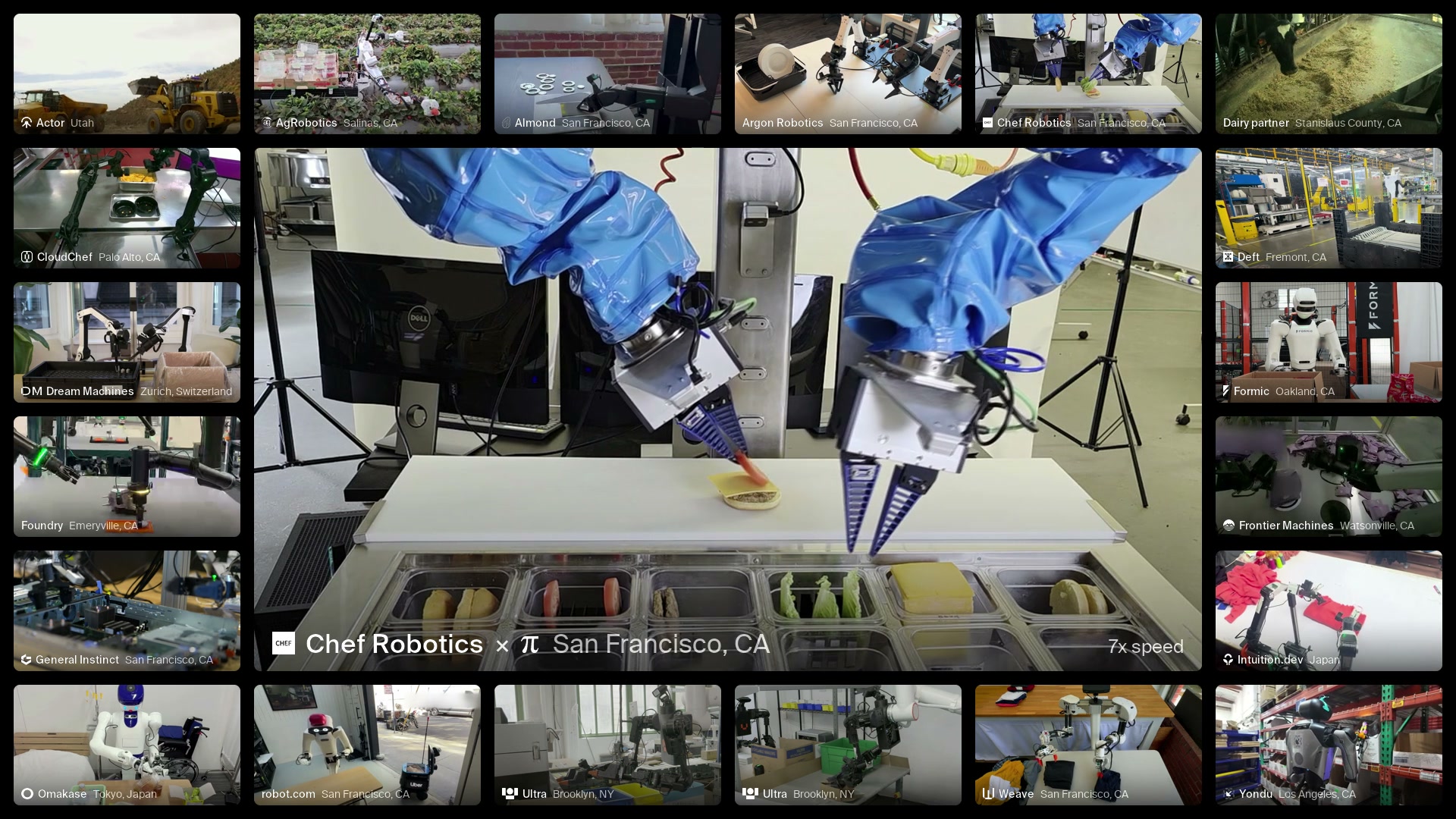
The Oct 13 beta turns that pattern into a product. A developer uploads demonstrations, Pi fine-tunes a model on compute it manages, and the robot calls a hosted inference gateway. Early users named in the post include Almond, Chef Robotics, Formic, Foundry and Ultra, with deployments from Japan to Switzerland and across the US; Almond reached a usable deburring model after four days of iteration. Formic said on Oct 22 that it is adapting Pi's models for factory work (our story). Pi itself reported network connectivity problems for some cloud-inference users, the plainest technical limit of the approach. It has disclosed no pricing, revenue or customer count.
How Pi compares with Skild AI and Figure
- HQ
- San Francisco
- Pittsburgh
- San Jose
- What it sells
- π models, Pi API beta
- Skild Brain model
- Figure 03 humanoid with Helix model
- Own hardware
- No
- No
- Yes, BotQ plant
- Latest disclosed round
- USD 600m Series B, Nov 2025 (reported)
- USD 1.4bn Series C, Jan 2026
- Over USD 1bn Series C, Sep 2025
- Valuation
- USD 5.6bn (reported); USD 20bn talks reported Oct 2026
- Above USD 14bn
- USD 39bn
- Commercial figure disclosed
- None; partner metrics only
- Over USD 100m ARR, 60+ paying customers
- 350+ Figure 03 delivered by Apr 2026
Sources: MEKAWIRE funding database and explainers; Skild and Figure rows from company announcements; Physical Intelligence funding rows are reported by outlets (CNBC, Bloomberg) and not announced by the company. Step-up = later valuation / earlier valuation.
As of Oct 31, 2026
The three companies hold three different positions. Skild AI also sells one model to run many robots and has disclosed revenue: more than USD 100m in annual recurring revenue and over 60 paying customers. Figure builds its own humanoid, Figure 03, and the Helix model that runs it, and said its BotQ plant had delivered more than 350 robots by April 2026. Pi has disclosed neither revenue nor robot counts. Its public evidence is research results and partner metrics.
Pi has not announced its funding rounds on its own site. MEKAWIRE's database holds two reported rows: about USD 400m at about USD 2.4bn in November 2024, and USD 600m at USD 5.6bn in November 2025 led by CapitalG. On Oct 27, 2026 Bloomberg reported that Pi is in talks to raise about USD 1bn at about USD 20bn (our story); the company has not confirmed it. By MEKAWIRE's arithmetic the reported valuation rose 2.3 times in 381 days between the two rows. A USD 20bn round would be 3.6 times the last reported figure, above Skild's disclosed USD 14bn and about half of Figure's USD 39bn.
MEKAWIRE analysis
Pi is betting that robot intelligence becomes a shared layer bought by API, as language models became for software, and the Oct 13 beta is the first test of whether robot builders will pay for it.
The evidence for the bet is stronger than a lab demo. The Weave and Ultra figures come from live customer sites, the API list spans kitchens, farms, factories and an autonomous wheel loader, and open π0 weights gave Pi a developer base before it had a product. The strongest counter-argument is that robots are not chat windows. Control loops need low latency, robot data is costly and site-specific, and Pi's own post concedes connectivity trouble with cloud inference. Figure keeps its model in-house on the view that tight hardware integration wins, and Skild has shown revenue that Pi has not.
Bull case: the API becomes the default starting point for robot start-ups, partner data flows back into pre-training as it did with Weave, and each model generation widens the gap. Bear case: large robot makers train their own models, start-ups use open weights without paying, and Pi's valuation runs far ahead of any disclosed sales.
What would change our view: a disclosed customer count or revenue figure from Pi, published API pricing, or a large robot maker naming Pi as its model supplier. Signals to watch: whether Pi or its lead investors announce the reported USD 1bn round, and at what price; whether the API leaves beta with published terms; and the next model after π0.7, with numbers on robots it was not trained on.
- π0 (Oct 2024), π0.5 (Apr 2025), π*0.6 (Nov 2025), π0.7 (Apr 2026)
- Pi API beta (Oct 13, 2026): upload data, fine-tune, hosted inference
- Not disclosed
- San Francisco developer of general-purpose robot AI models (VLA); builds no robots
- π0 and π0-FAST code and weights in openpi (Feb 4, 2025)
- Weave: missed grasps down 42%, interventions down 50%; Ultra: 96.4% autonomy over a shift
- USD 600m at USD 5.6bn, Nov 2025; USD 1bn at USD 20bn talks reported Oct 27, 2026